

Other cookies are configurable.
Best AI Visibility Tool in 2026: 12 Options We Compared on One Real Brand


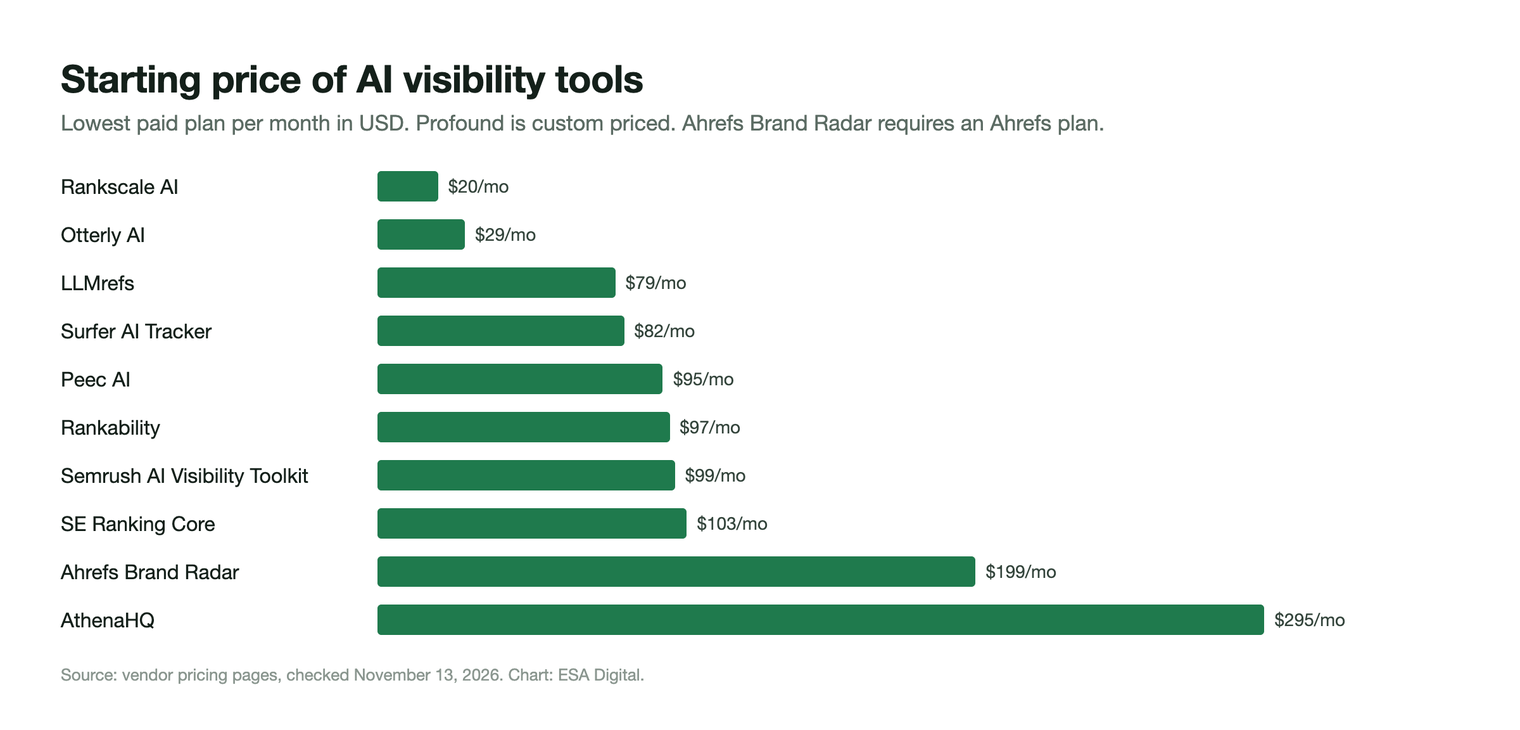
The best AI visibility tool for most teams in 2026 is the one that matches your stack. Ahrefs Brand Radar and Semrush AI Visibility Toolkit suit teams already on those suites, Peec AI suits dedicated AI search analytics, Otterly AI and Rankscale AI suit small budgets, and Profound suits enterprises.
That is the short answer. Below it sit twelve AI search visibility tools, one hands-on test and a plain account of what these visibility tools can and cannot tell you. The longer answer matters more, because every AI visibility tool measures a slightly different thing, and the numbers rarely agree.
The short list: best AI visibility tools by use case
| Tool | Best for | Starting price | Engines |
|---|---|---|---|
| Ahrefs Brand Radar | Teams on Ahrefs, large prompt index | From $199/mo per AI index | ChatGPT, Perplexity, Gemini, Copilot, Google AI Overviews and Mode, Claude (custom prompts) |
| Semrush AI Visibility Toolkit | Teams on Semrush | $99/mo per domain | ChatGPT, Google AI, Gemini, Perplexity |
| SE Ranking | SEO platform with AI tracking built in | 25 prompts included in Core | ChatGPT, Gemini, Copilot, Google AI Overviews and Mode |
| Surfer AI Tracker | Content teams on Surfer | $82/mo billed yearly | ChatGPT, Perplexity, Gemini, Google AI Overviews and Mode |
| Peec AI | Dedicated AI search analytics | $95/mo | Any 3 of: ChatGPT, Perplexity, Gemini, AI Overviews, AI Mode, Bing, Naver, ERNIE |
| Profound | Enterprise brands | Custom enterprise pricing | Up to 10: ChatGPT, Claude, Gemini, Perplexity, DeepSeek, Qwen, AI Overviews, AI Mode, Exa, Muse Spark |
| Otterly AI | Affordable entry point | $29/mo | ChatGPT, Perplexity, Copilot, Google AI Overviews. Add-ons: Gemini, Claude, AI Mode |
| Rankscale AI | Lowest paid entry | About $20 (€20)/mo | 17+, incl. ChatGPT, Claude, Gemini, Perplexity, Copilot, Grok, DeepSeek, Mistral, AI Overviews, AI Mode |
| LLMrefs | Solo marketers and startups | $79/mo | ChatGPT, Claude, Gemini, Perplexity, Grok, Copilot, Meta AI, AI Overviews, AI Mode |
| Rankability | Agencies needing SEO and AI visibility | $97/mo | ChatGPT, Claude, Gemini, Perplexity, Grok, Copilot, Meta AI, DeepSeek, Brave AI, AI Overviews, AI Mode |
| AthenaHQ | Mid-market brands | $295/mo | ChatGPT, Claude, Gemini, Perplexity, Copilot, Grok, DeepSeek, Meta AI, Mistral, AI Overviews, AI Mode |
| Google Search Console | Free baseline | Free | Google Search only, AI features not separated |
What are AI visibility tools?
AI visibility tools are software that track how often, and in what way, a brand appears in AI generated answers. They send prompts to AI platforms such as ChatGPT, Perplexity, Gemini and Google AI Overviews, then record brand mentions, citations and sentiment.
How an AI visibility tool tracks a brand
An AI visibility tool tracks a brand in three steps. It runs a set of prompts on a schedule, it stores each answer, and it parses the answer for brand names and cited URLs. The output is visibility data you can chart over time.
What these tools measure
Most AI search visibility tools report the same four AI visibility metrics, and the best AI search products add a fifth:
- Mention rate. How often the brand appears in answers to a prompt set.
- Citation share. How often your URLs are cited as sources.
- Sentiment. How AI systems describe the brand when they mention it.
-
Prompt coverage. How many relevant prompts trigger any mention at all.
-
Share of voice. How your brand mentions compare with named competitors.
How they differ from traditional SEO tools
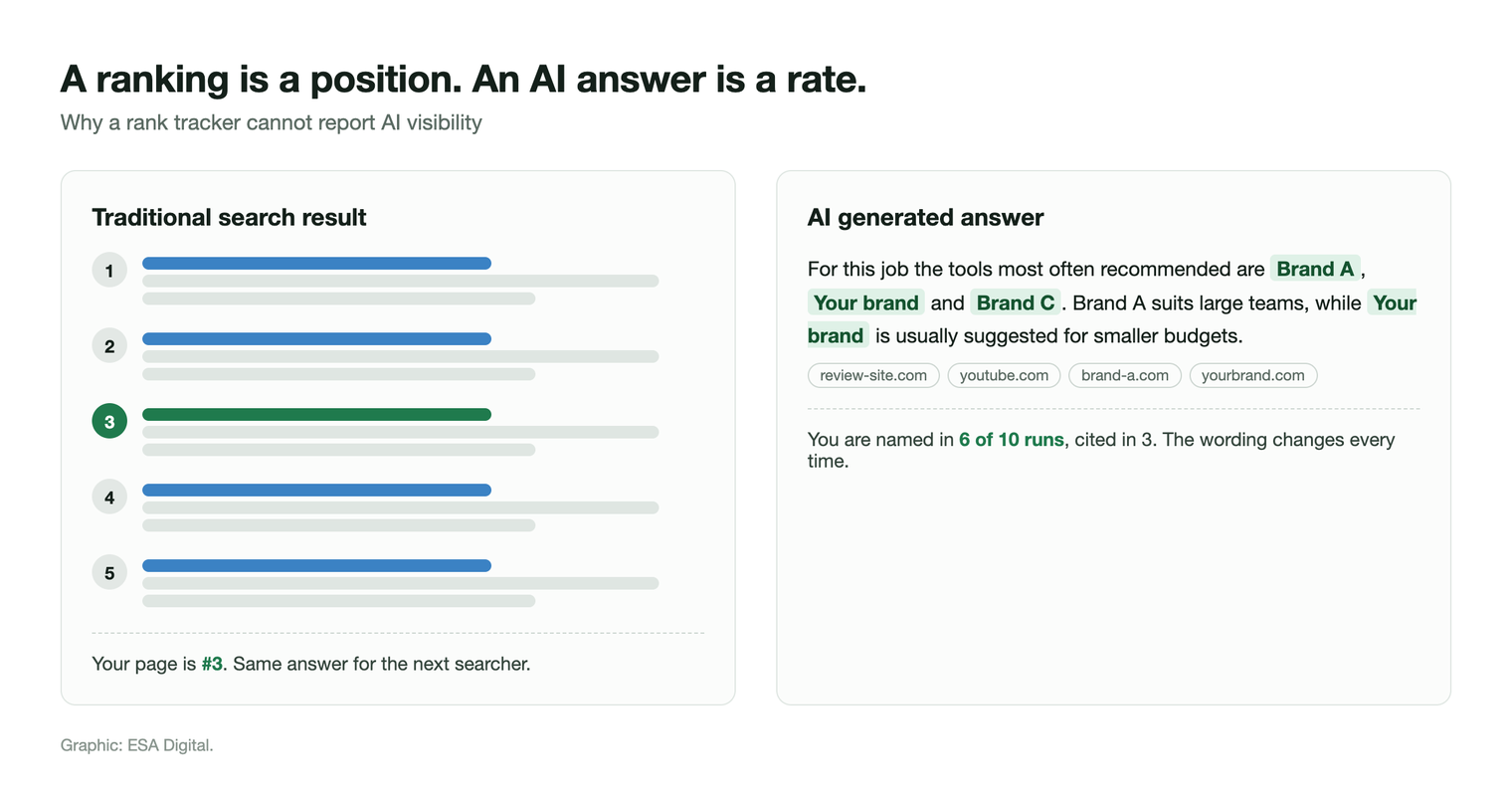
Traditional SEO tools track a position for a keyword. A page ranks third or it does not. AI answers have no fixed positions. The same prompt can produce a different answer an hour later, in another country, or for a logged-in user.
That is why traditional rank tracking does not transfer directly. AI visibility tracking samples answers many times and reports a rate.
Why AI search visibility needs its own tracking
AI visibility tools are essential as search moves from traditional SEO to conversational AI. The industry calls the wider practice Generative Engine Optimization, or GEO, and AI brand visibility tools are its measurement layer.
Search is moving from ten links to one written answer. Traditional search visibility still matters, but a brand can rank well in search engines and be absent from the answer above the results.
AI answers pull from more than rankings
Research by RESONEO into Google's internal schemas describes how Google AI Overviews and Google AI Mode build an answer. The system receives the ranked web results, plus about 100 specialized providers, plus facts from the Knowledge Graph that arrive as plain text with no URL attached.
A linked web page is only one of nine source types the answer can draw on. So AI mentions and citations are separate things, and AI search visibility depends on both.
Visibility differs across AI engines
Multi-engine tracking is necessary because visibility can vary drastically among different AI models. Our own test below shows one competitor with almost six times more mentions in one engine than in another. A single-engine tracker would have missed that entirely. Tracking visibility on one engine tells you little about brand visibility on the next.
Google says no special optimization is needed
Google states that no special optimization is needed for inclusion in its AI features beyond normal SEO practice. That is true as far as eligibility goes. It does not tell you whether your brand appears, how it is described, or who is cited instead. AI visibility tracking fills that gap. It shows how AI systems describe your brand across AI platforms, which no ranking report can.
How we evaluated the tools
Our position
We run SEO and GEO programs for SaaS and app companies. We use Ahrefs and Surfer every working day. We used Ahrefs Brand Radar and Surfer AI Tracker hands-on for this article. For the other tools we read the documentation and checked every price on the vendor's own pricing page on November 13, 2026.
We mark which is which in each review. We would rather say "not tested hands-on" than pretend.
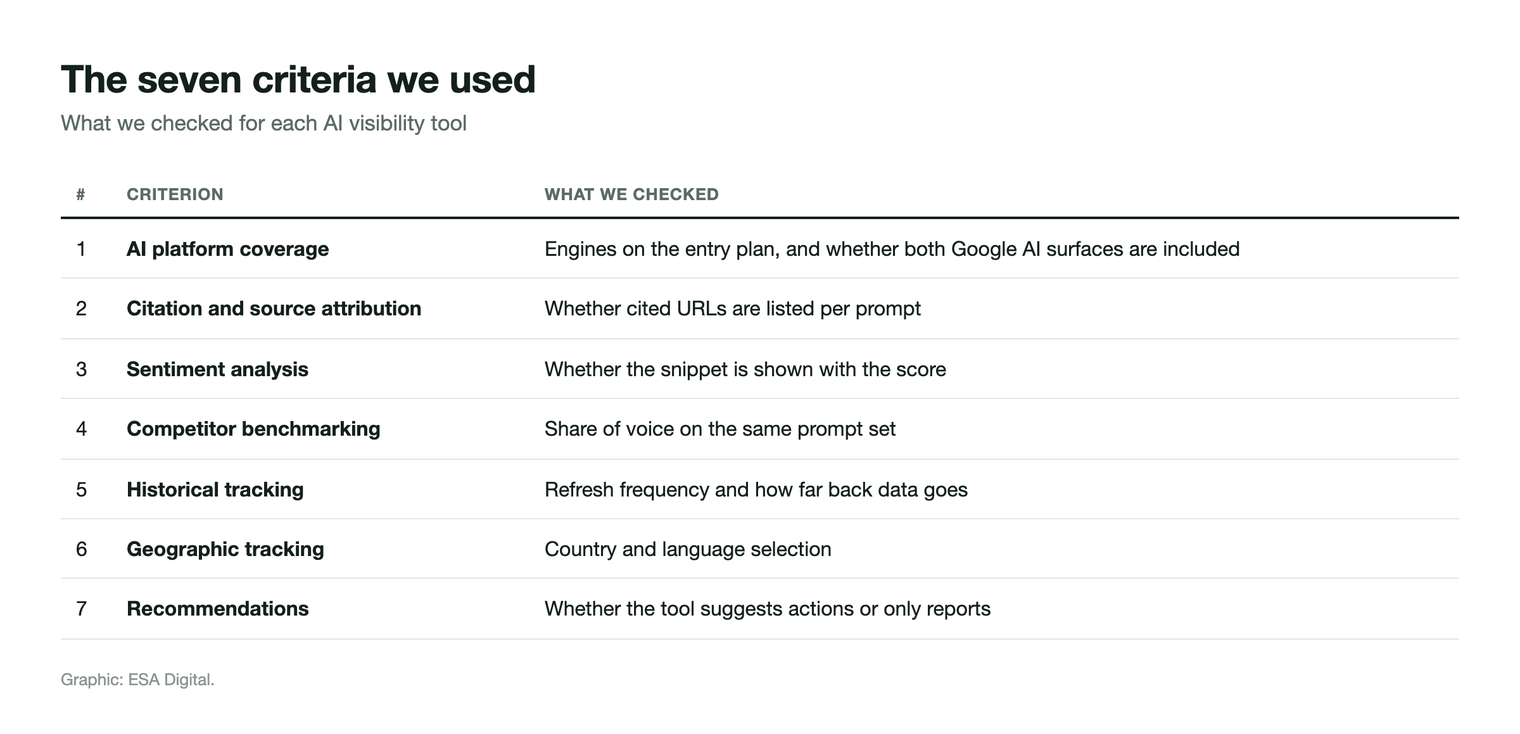
The seven criteria
- AI platform coverage. Which AI platforms are tracked, and whether both of Google's AI surfaces are included.
- Citation and source attribution. Whether the tool shows the specific URLs cited when AI generates an answer.
- Sentiment analysis. Whether it reports how the brand is described, with the snippet.
- Competitor benchmarking. Whether it lets you compare visibility against rivals on the same prompts.
- Historical tracking. Whether you can measure change over time.
- Geographic tracking. AI responses differ by location, so country selection matters.
- Recommendations. Whether the tool suggests actions, or only reports.
What we left out
We excluded tools that only check whether AI crawlers can access a site, and tools with no public pricing or trial.
Key features to compare in AI search visibility tools
The best AI search visibility tools share a core feature set. The differences are in depth, and in how much each feature costs to switch on. We scored all twelve search visibility tools on the features below.
AI platform coverage
Check that the tool covers the major AI platforms your buyers use. At minimum that means ChatGPT, Perplexity, Google AI Overviews and Gemini. An AI search visibility tool that tracks one engine gives you one opinion.
Citation analysis and source attribution
Citation analysis shows which pages AI systems rely on when they answer. A good AI search visibility tool lists every cited URL per prompt, so you can see who earns the citation when you do not. This is the feature we used most in our test.
Sentiment analysis
Sentiment analysis is crucial to understand how brands are perceived by AI. A mention that calls your product "expensive and dated" is not a win. Look for sentiment analysis that shows the snippet, not just a score.
Competitor benchmarking
Competitor benchmarking allows brands to compare their visibility against rivals on the same prompts. Share of voice is the usual output. Without it, a rising mention count means little, because the whole category may be rising.
Prompt tracking and prompt research
Prompt tracking is the core job. Prompt research is the newer feature. AI platforms analyze real prompt data to capture the questions users ask about brands, and the better tools surface those questions for you. Think of it as keyword research for AI search.
Historical tracking
Historical tracking helps measure changes in AI visibility over time. Daily checks matter less than a stable prompt set that you keep for months. Visibility tracking without history is a snapshot.
Geographic tracking
AI search results differ by country and language. If you sell in several markets, an AI search visibility tool without country selection will mislead you. Our test brand had most of its visibility outside English.
Crawler and agent analytics
Some tools also log visits from AI crawlers and AI agents to your site. It is useful for technical teams. It is not the same as AI visibility tracking, and it should not be the reason you buy.
Our test: one brand, three AI engines
The setup
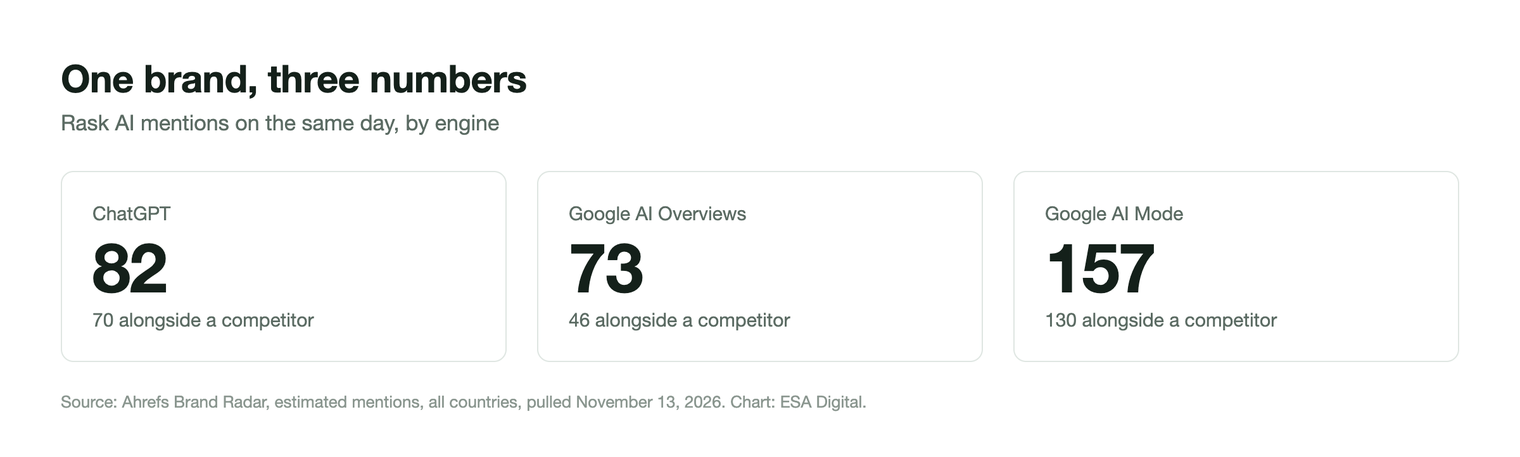
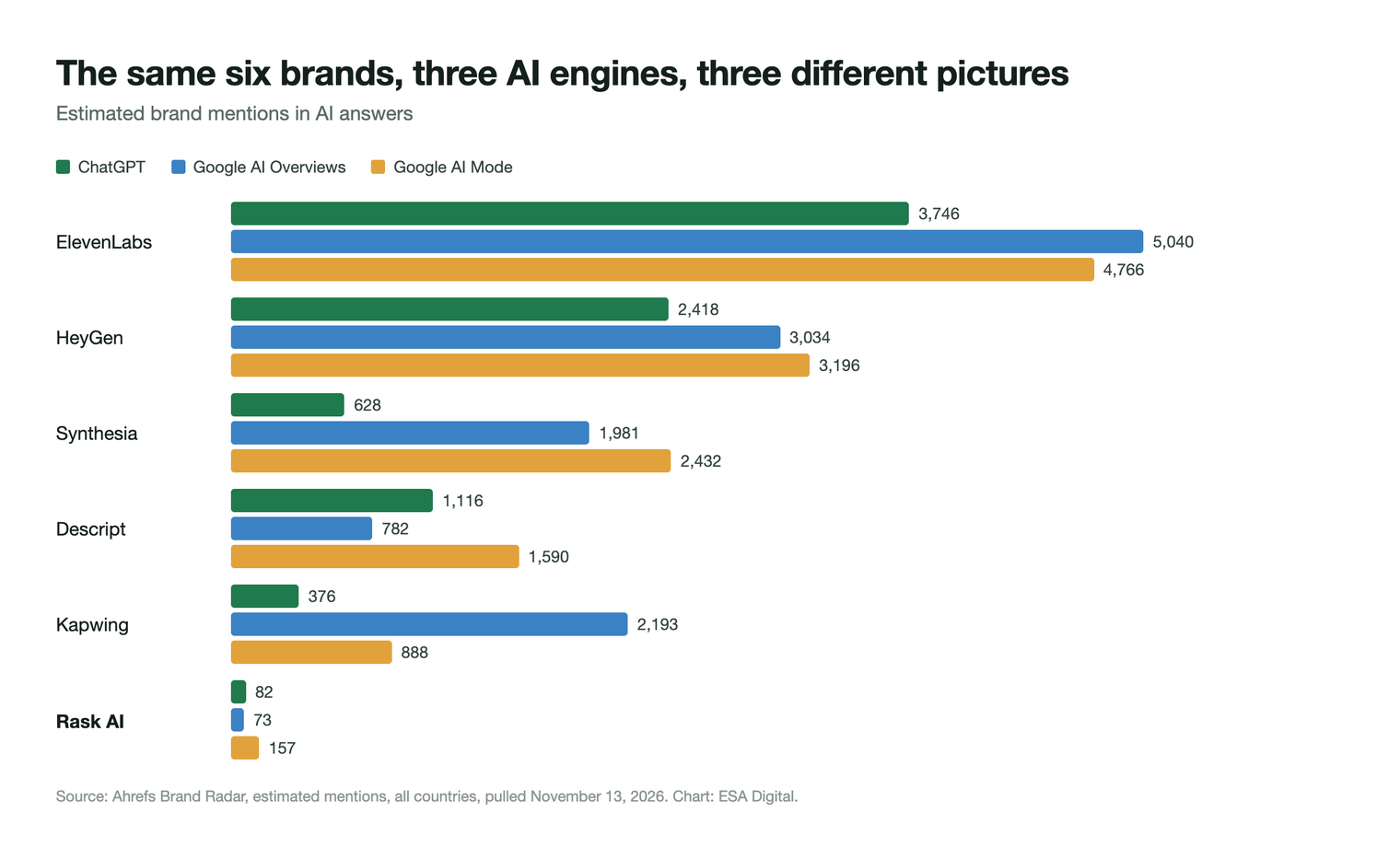
We used Ahrefs Brand Radar to track AI visibility for Rask AI, a video localization platform, and five competitors in AI video and voice: ElevenLabs, HeyGen, Synthesia, Descript and Kapwing. We pulled visibility data separately for ChatGPT, Google AI Overviews and Google AI Mode on November 13, 2026, with no country filter.
Mentions by engine
| Brand | ChatGPT | Google AI Overviews | Google AI Mode |
|---|---|---|---|
| ElevenLabs | 3,746 | 5,040 | 4,766 |
| HeyGen | 2,418 | 3,034 | 3,196 |
| Synthesia | 628 | 1,981 | 2,432 |
| Descript | 1,116 | 782 | 1,590 |
| Kapwing | 376 | 2,193 | 888 |
| Rask AI | 82 | 73 | 157 |
Estimated mentions in the Ahrefs prompt index.
What the test showed
The engines disagree, sometimes by a wide margin. Kapwing has 5.8 times more mentions in AI Overviews than in ChatGPT. Synthesia has 3.9 times more in Google's conversational mode than in ChatGPT. Descript goes the other way and is stronger in ChatGPT than in AI Overviews.
Even Google's two surfaces differ. Rask AI has 157 mentions in one and 73 in the other, more than double, inside the same company's products.
The brand appears mostly next to competitors. In ChatGPT, 70 of the 82 Rask AI mentions came in answers that also named a competitor. The brand is a list entry far more often than it is the answer.
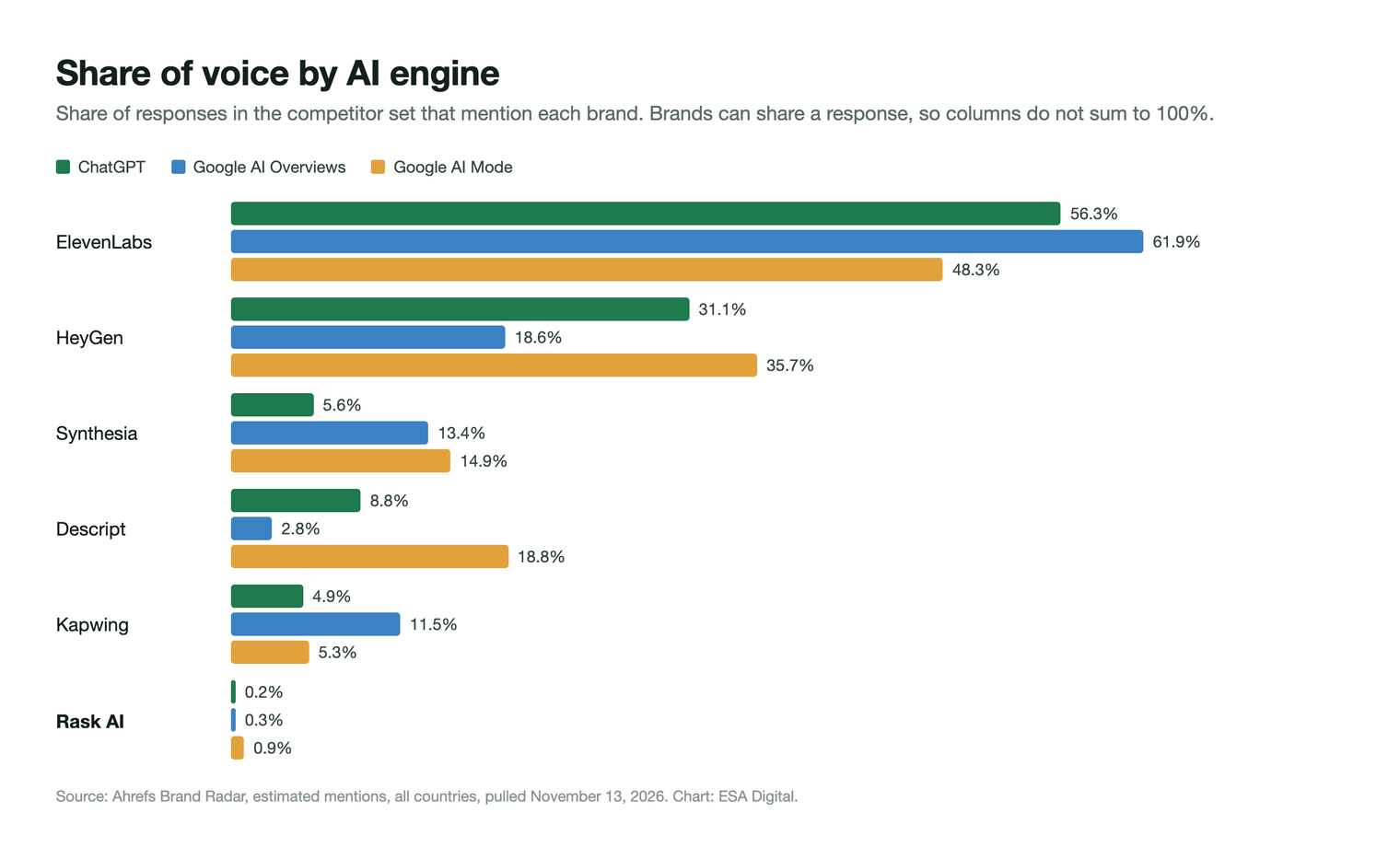
Share of voice puts the gap in one number. Rask AI holds 0.2% share of voice in ChatGPT, 0.3% and 0.9% in the two Google surfaces against this competitor set. ElevenLabs holds between 48% and 62%.
Citations tell a different story
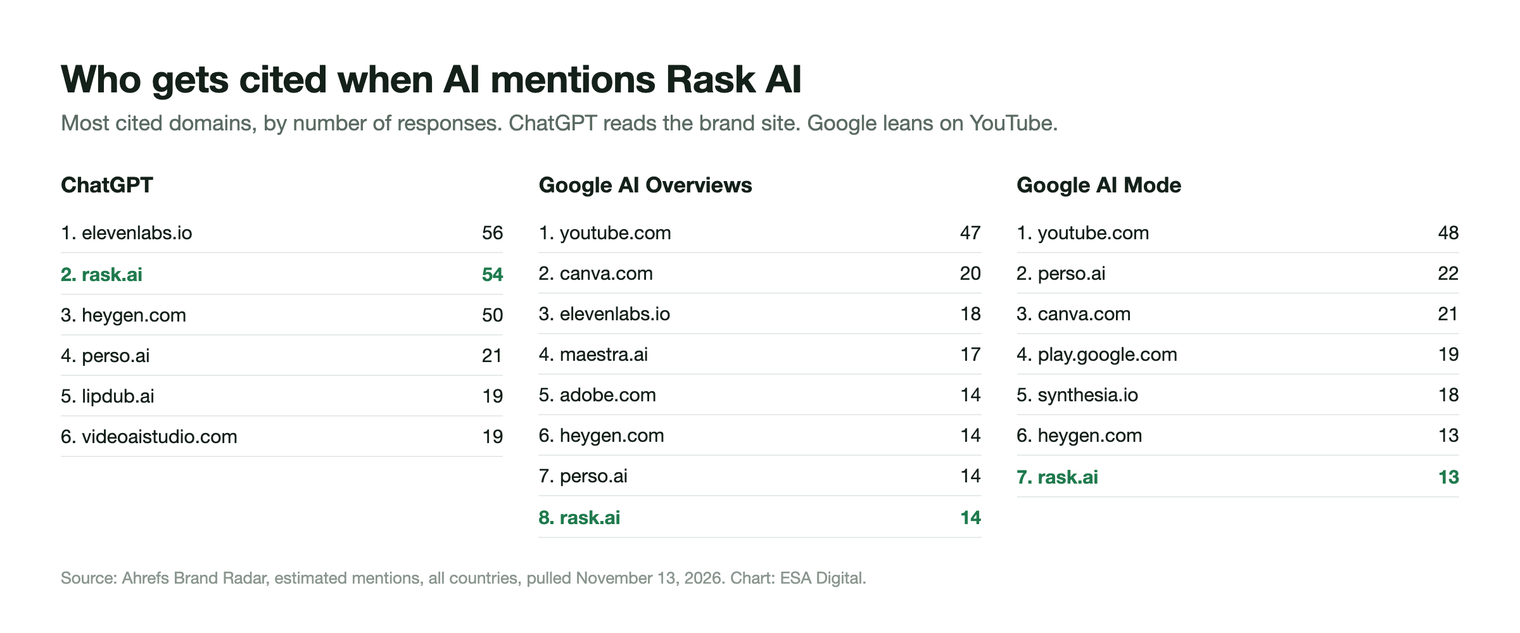
| Engine | Most cited domain | Where rask.ai ranked |
|---|---|---|
| ChatGPT | elevenlabs.io (56 responses) | 2nd, 54 responses |
| Google AI Overviews | youtube.com (47 responses) | 8th, 14 responses |
| Google AI Mode | youtube.com (48 responses) | 7th, 13 responses |
In ChatGPT, the brand's own site is the second most cited source in answers that mention it. In both Google surfaces, YouTube leads and the brand's site drops to the middle of the list.
The practical conclusion for this brand is specific. ChatGPT already reads the website. Google's AI features lean on video, so YouTube content deserves more attention than another blog post.
Sentiment and language
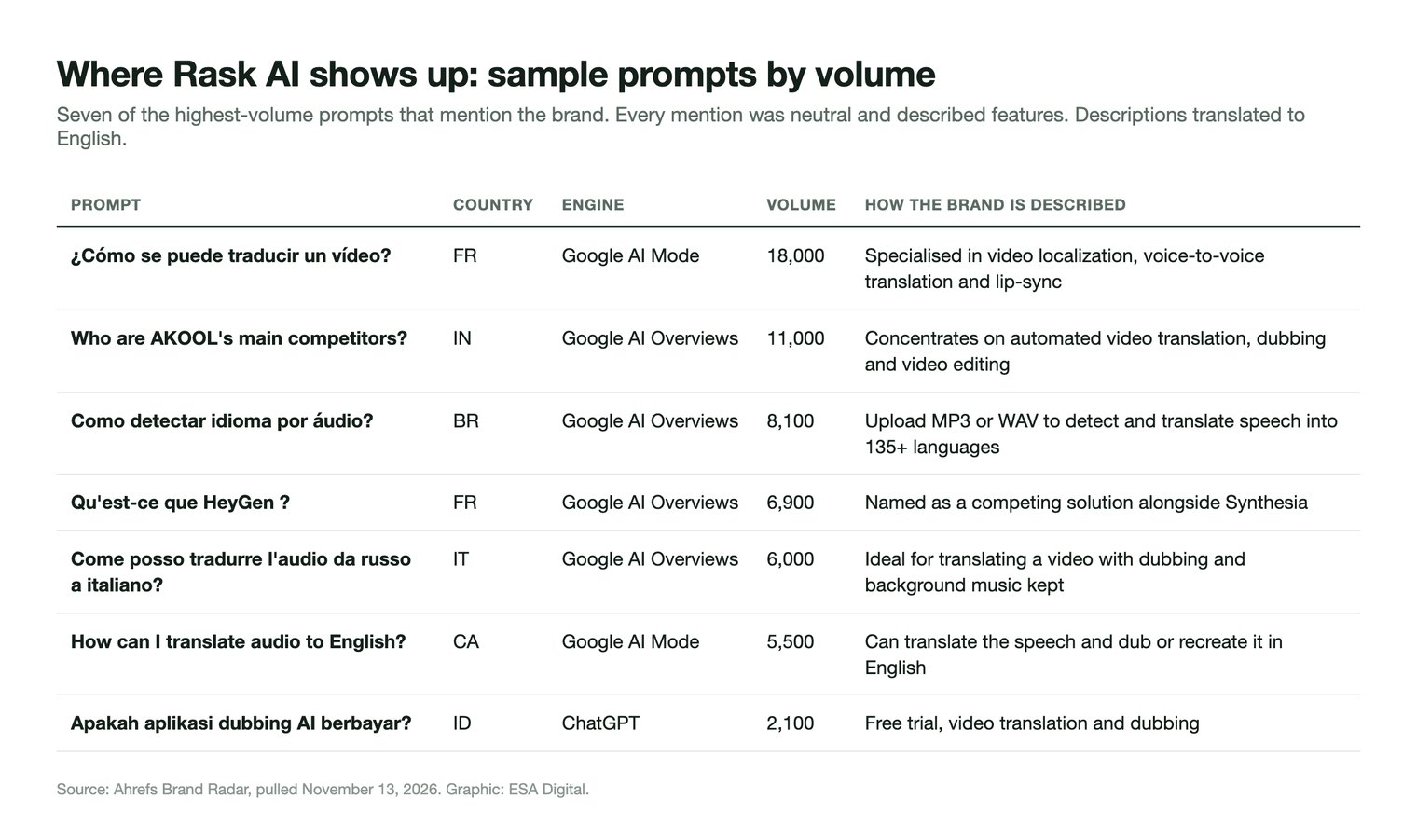
Every sampled mention was neutral and described features, such as lip-sync and support for more than 135 languages. The highest-volume prompts were not in English. They were in Spanish, Portuguese, French, Italian and Indonesian.
An AI search visibility tool with English-only prompts would have missed most of this brand's visible footprint.
The 12 best AI search visibility tools, reviewed
Each review below follows the same order: who the AI search visibility tool is for, what it tracks, what it costs, and where it falls short.
1. Ahrefs Brand Radar
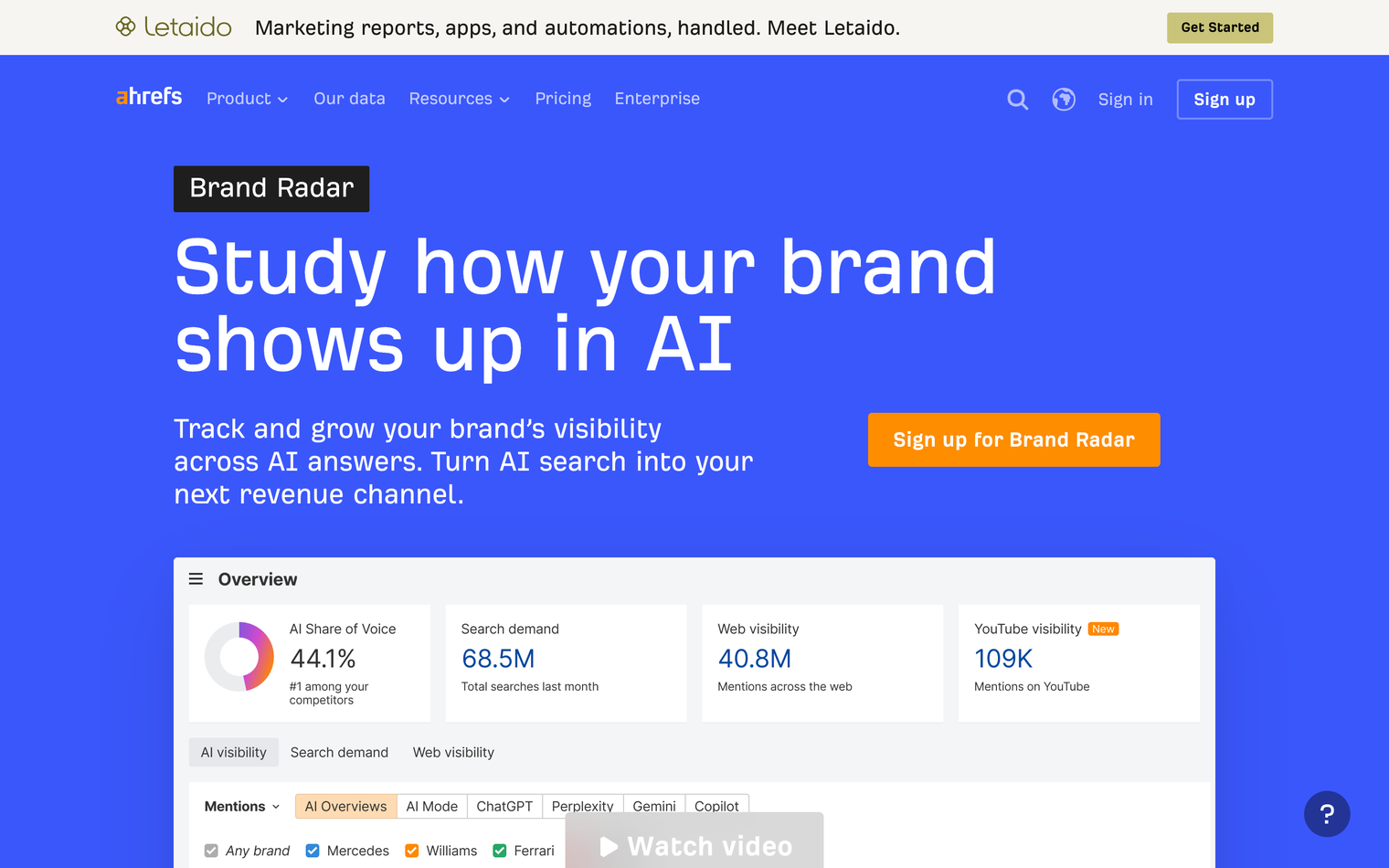
Ahrefs Brand Radar is an index-based AI search visibility tool. You search a brand and get mentions, share of voice and cited pages straight away, with no setup. Its product page states an index of 558 million prompts. Older reviews cite around 387 million monthly prompts.
Best for
Teams already on Ahrefs who want competitor benchmarking on day one.
What it tracks
Brand mentions, share of voice, cited domains and pages, and sentiment with snippets. Coverage includes ChatGPT, Perplexity, Google AI Overviews and its sister mode, Gemini and Copilot, with Claude for custom prompts.
Pricing
Brand Radar is an add-on to an Ahrefs plan. It starts from $199 per month for one AI index, $398 per month for selected coverage, and $699 for all platforms. Paid plans include a small number of free custom prompts.
What we found
Hands-on. The index is the strength. We got six brands across three engines in minutes. The weakness is that each engine is a separate purchase. Our subscription did not include Perplexity or Gemini, so those columns are missing from our test.
2. Semrush AI Visibility Toolkit
Semrush AI Visibility Toolkit adds AI visibility data to an established SEO platform. Semrush says its database holds over 261 million prompts across AI platforms.
Best for
Teams that already run keyword research and audits in Semrush.
What it tracks
Mentions across ChatGPT, Google AI, Gemini and Perplexity. It includes competitor analysis, prompt research and a site audit for AI readiness.
Pricing
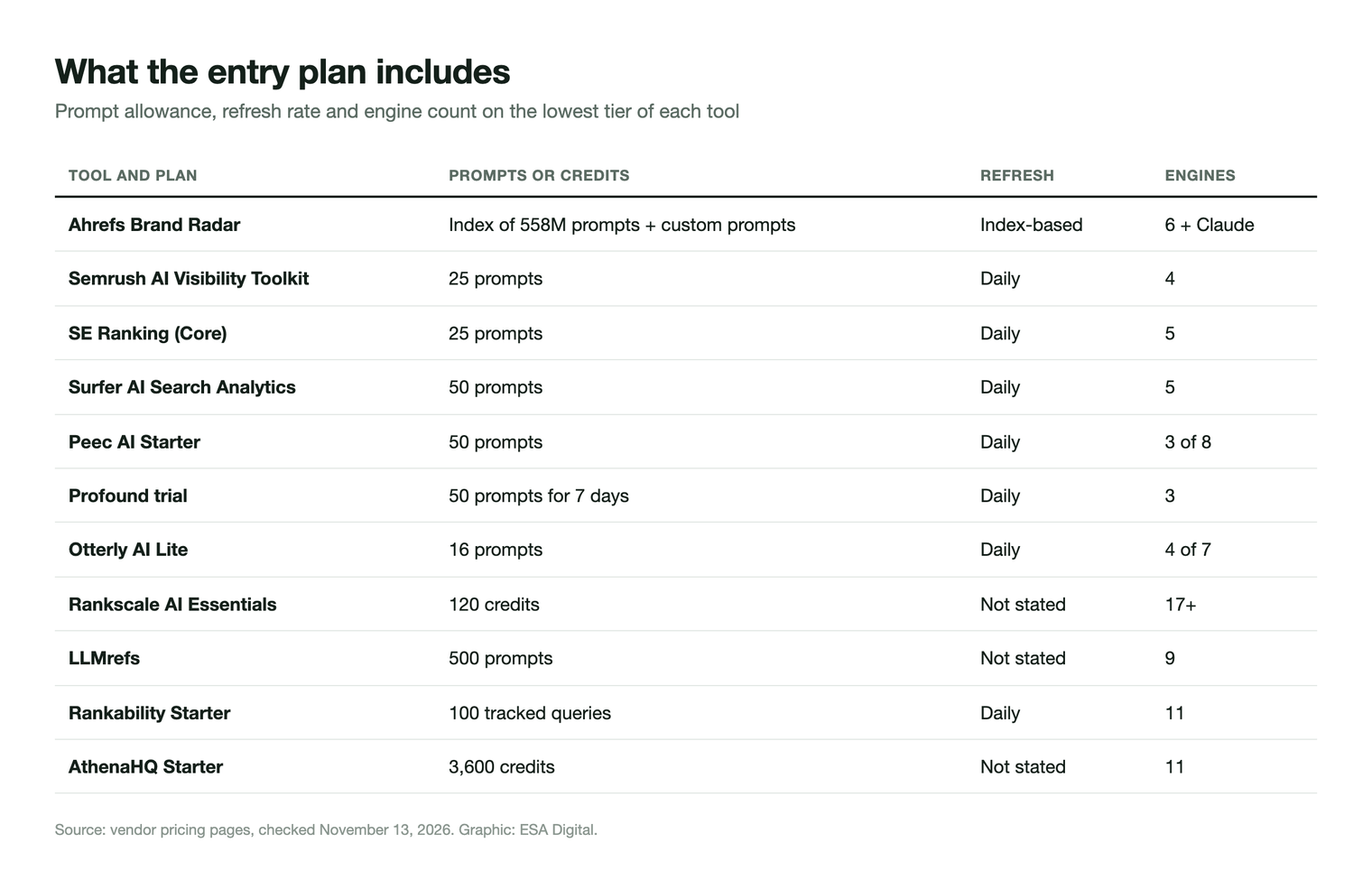
The Semrush AI Visibility Toolkit costs $99 per month per domain, billed annually, with 25 custom prompts tracked daily.
Limits
Not tested hands-on. Per-domain pricing adds up quickly for agencies with many clients.
3. SE Ranking
SE Ranking is a traditional SEO suite that added AI visibility features without a separate product. The Core and Growth plans include an AI visibility tracker with 25 prompts checked daily across five AI engines.
Best for
Small teams that want traditional search and AI search monitoring in one login.
What it tracks
SE Ranking covers both Google AI surfaces, Gemini, ChatGPT and Copilot, with visibility tracking alongside classic rank data. SE Ranking also reports competitor visibility on the same prompts.
Pricing
SE Ranking Core starts at about $103 per month billed annually. The larger AI add-on starts from about $70 per month, with tiers of 75, 200 and 1,000 prompts.
Limits
Not tested hands-on. SE Ranking also sells a standalone product, SE Visible, so check which one a review describes. Of the suites here, SE Ranking has the lowest cost of entry for AI visibility tracking.
4. Surfer AI Tracker
Surfer is a content optimization platform that added AI search analytics. We use Surfer for content briefs.
Best for
Content teams that want to see whether optimized pages earn citations.
What it tracks
Mentions and sources across five AI engines on the Pro plan, including ChatGPT, Perplexity and Gemini. It reports a mention gap against competitors and brand sentiment.
Pricing
The standalone AI Search Analytics plan is $82 per month billed yearly, with 50 prompts refreshed daily. The Standard plan includes 25 prompts refreshed weekly on ChatGPT only.
What we found
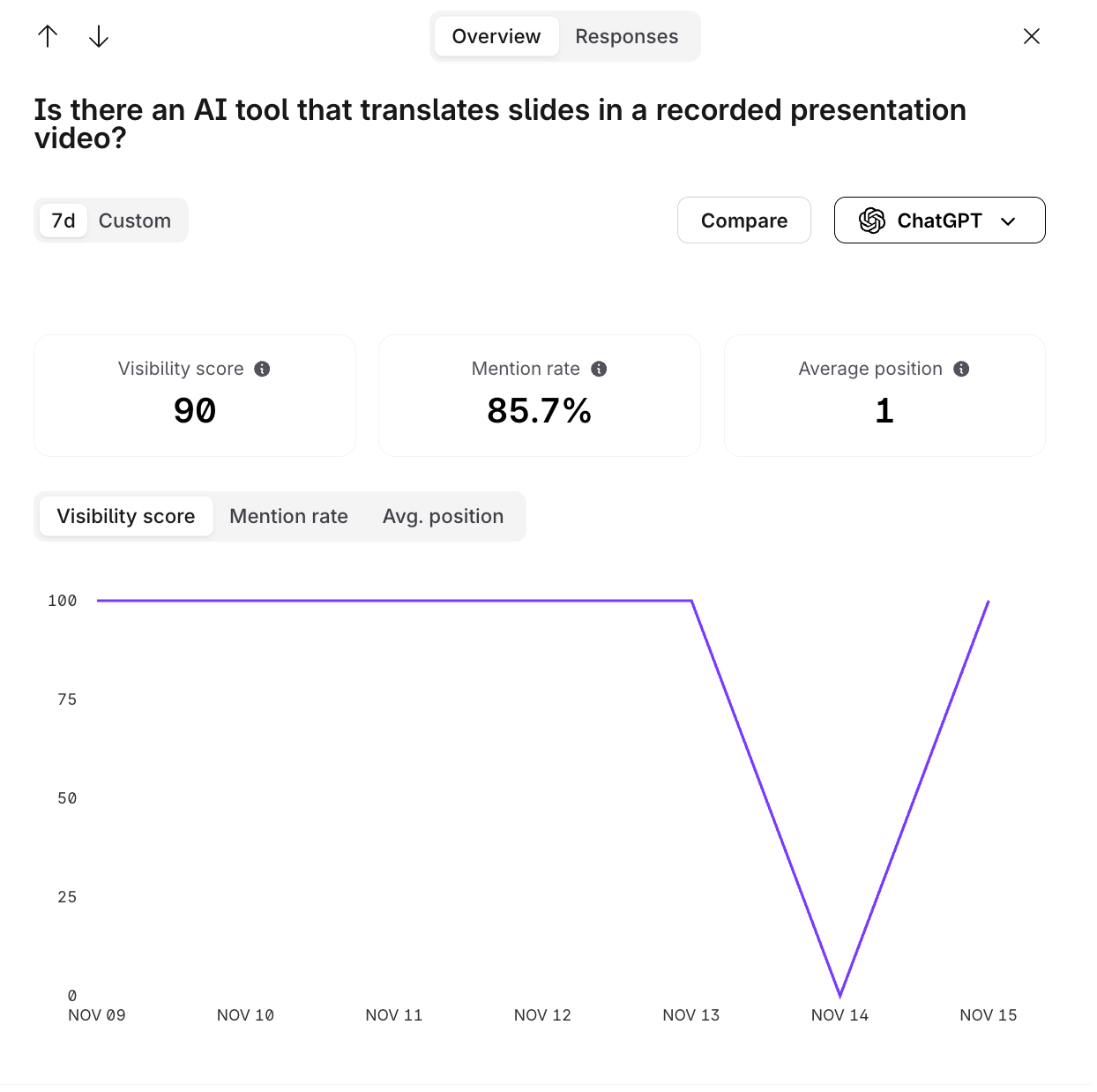
Hands-on. We tracked 14 prompts about one narrow topic, translating on-screen text in video, for the same brand over seven days. The screenshots show the ChatGPT view.
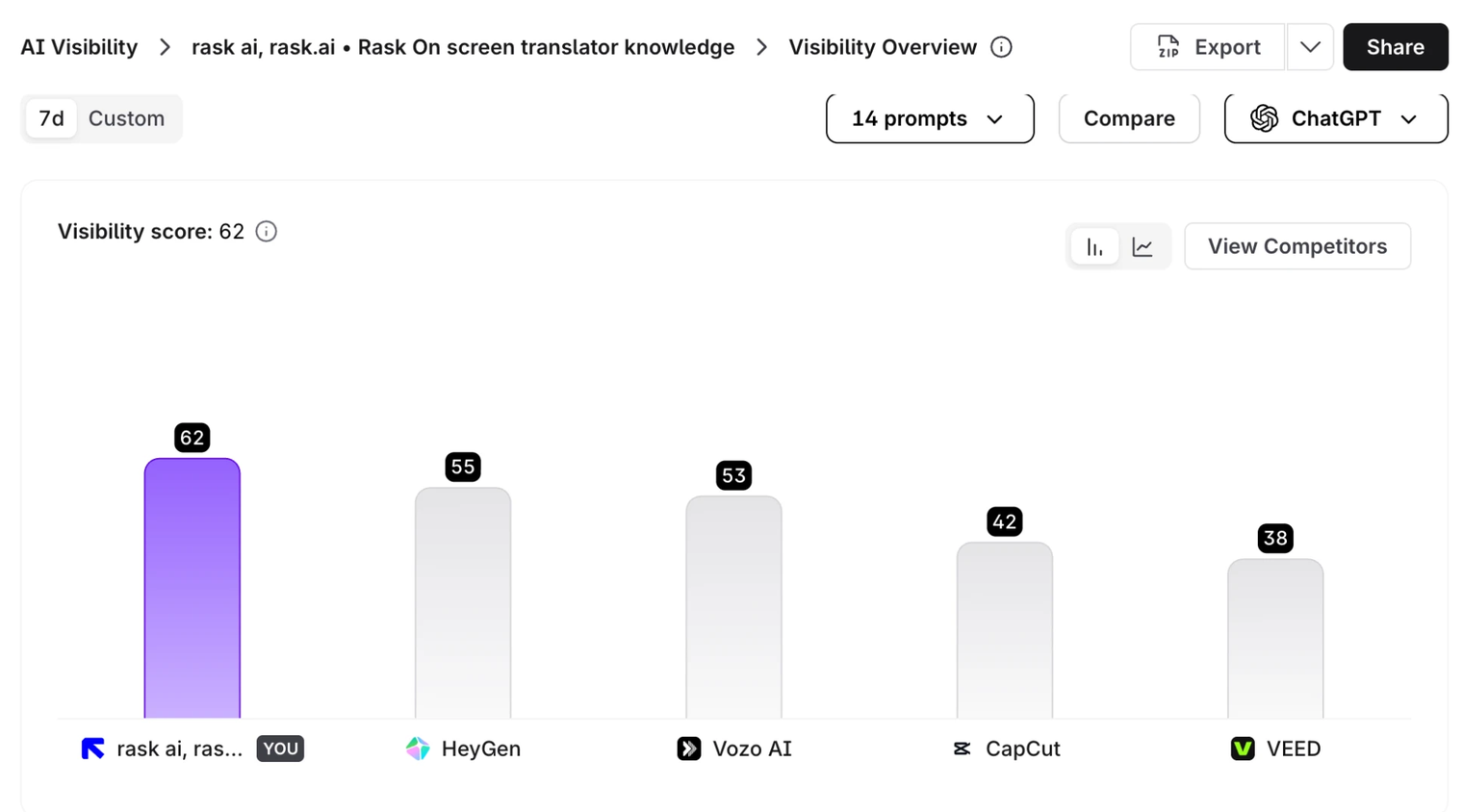
On this prompt set Rask AI led with a visibility score of 62, ahead of HeyGen at 55 and Vozo AI at 53. Its mention rate was 51% and its average position was 2.2.
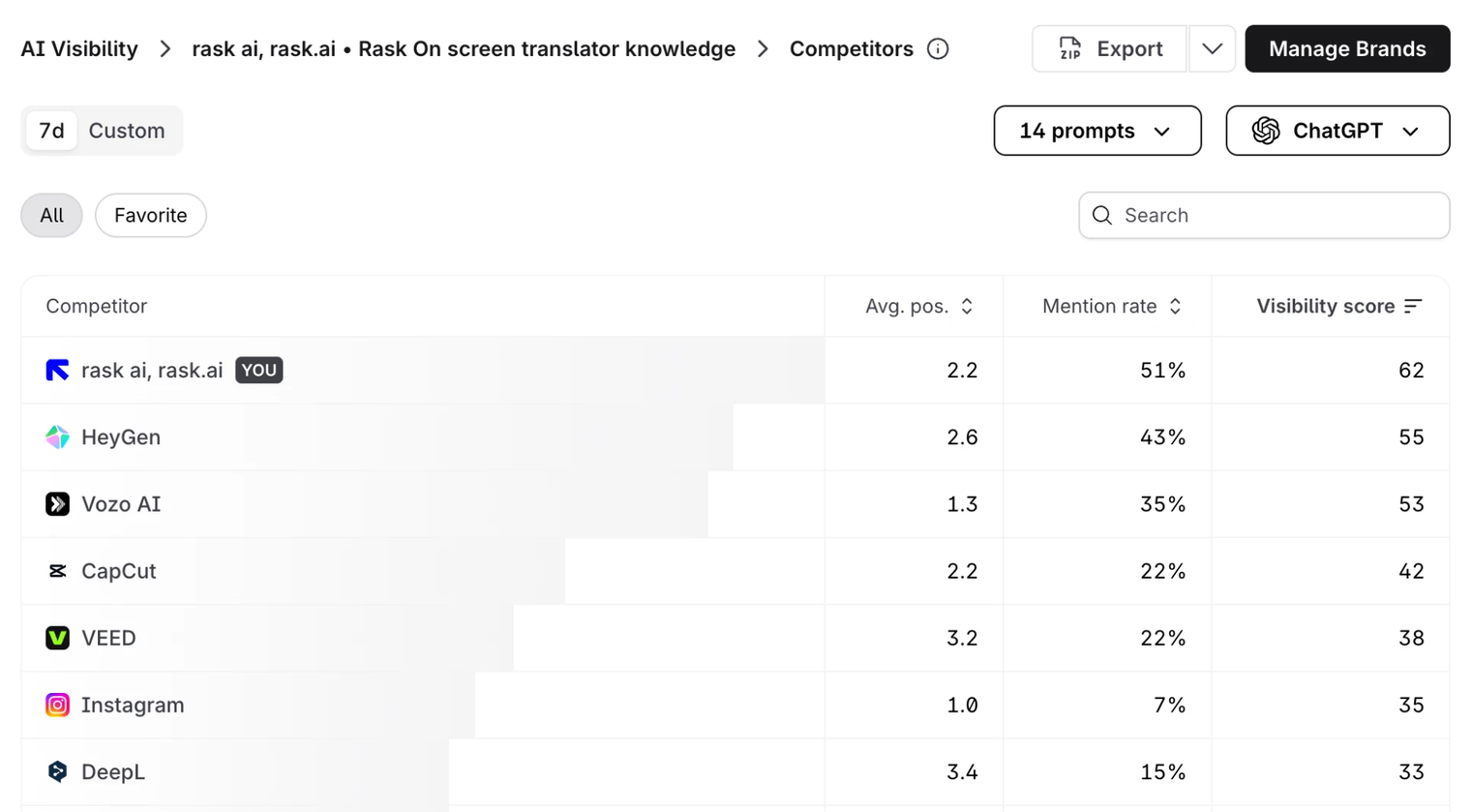
Compare that with the Brand Radar test above, where the same brand held under 1% share of voice. Both numbers are correct. One measures a whole category, the other measures 14 questions the brand should win.
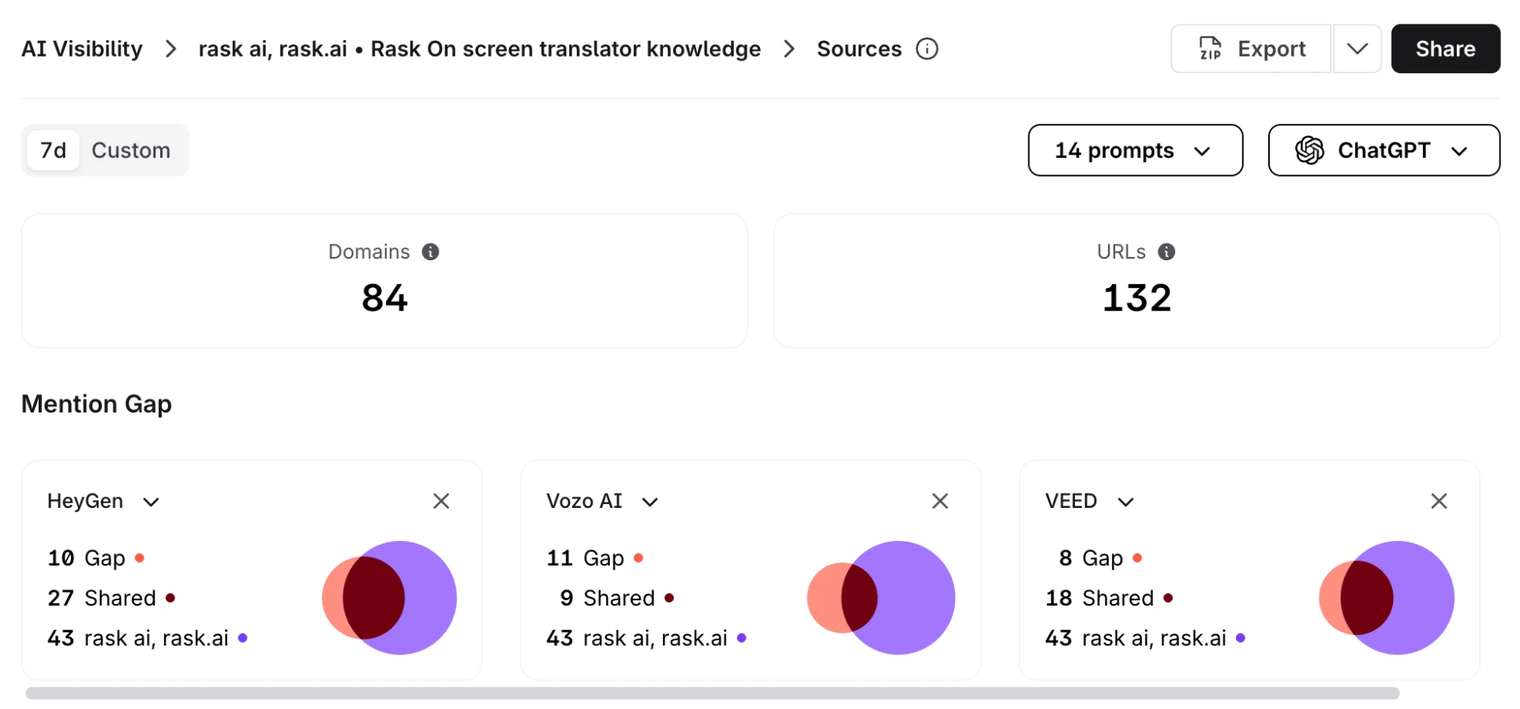
The sources report was the most useful screen. It counted 84 domains and 132 URLs that ChatGPT cited. The mention gap view showed 11 sources that name Vozo AI and not Rask AI, and 10 that name HeyGen and not Rask AI. That is a ready outreach list.
The prompt view showed how unstable a single prompt is. For one question the visibility score sat at 100 for five days, fell to zero on November 14, and was back at 100 the next day.
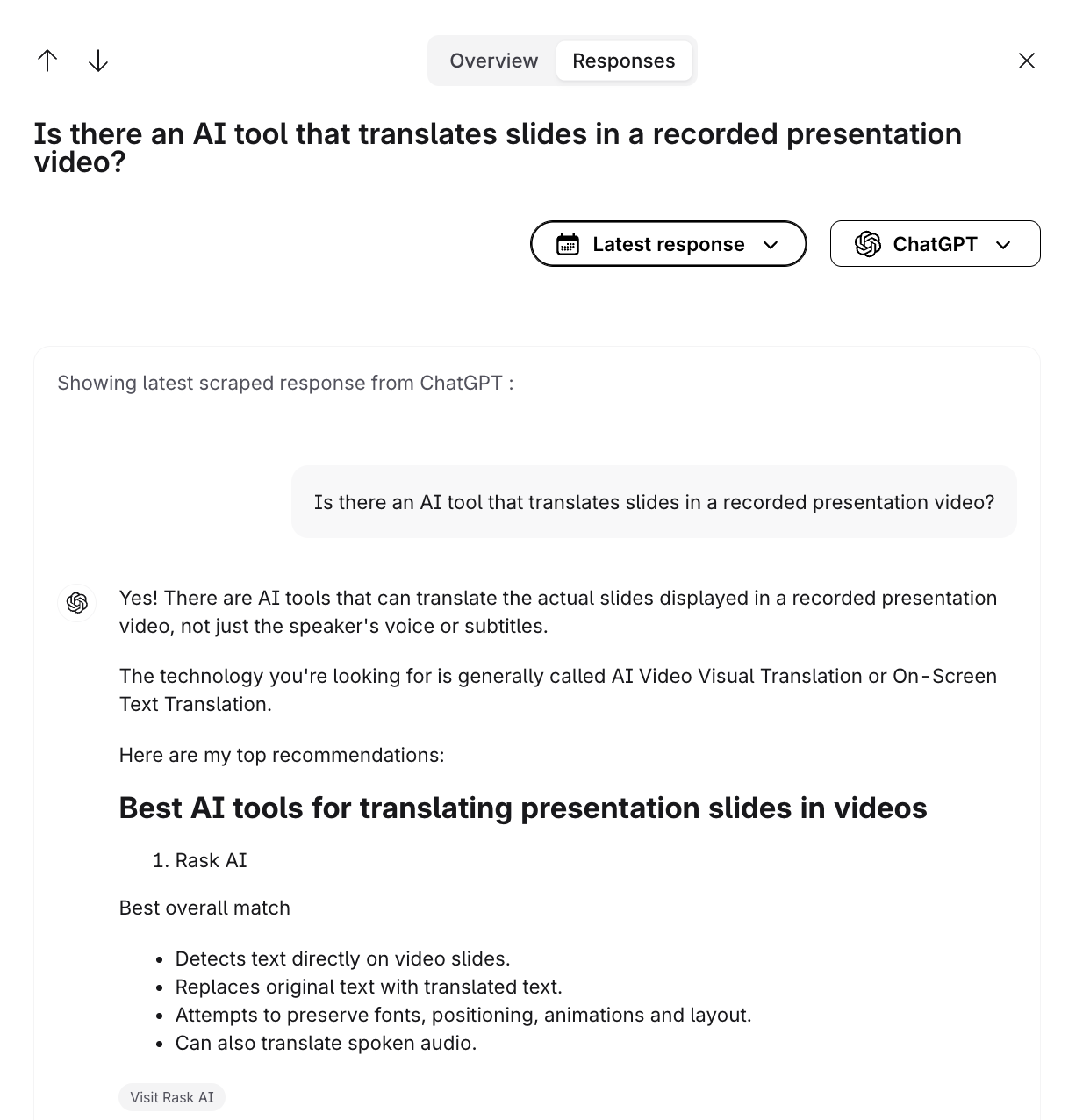
Surfer also stores the full answer, so you can read how the brand is described and not only whether it is named. For this prompt ChatGPT listed Rask AI first, as the best overall match, and described what the product does with slide text.
Limits
Weekly refresh on the lower plan is slow for a channel that changes daily.
5. Peec AI
Peec AI is a dedicated AI search monitoring tool. It does one job, and it is the tool most often named for pure AI search analytics.
Best for
Marketing teams that want prompt tracking without buying an SEO suite.
What it tracks
Peec AI offers daily tracking of brand visibility and sentiment, with source analysis and competitor comparison. You choose three active models from eight, including ChatGPT, Perplexity and both Google AI surfaces.
Pricing
Peec AI Starter is $95 per month for 50 prompts and one country. Pro is $245 for 150 prompts. Extra models cost from $30 per month.
Limits
Not tested hands-on. Three models per plan means the multi-engine picture costs extra.
6. Profound
Profound is built for large brands that need deep AI visibility monitoring. It offers the broadest engine coverage in this list, with up to 10 platforms tracked.
Best for
Enterprises with a dedicated AI search team and budget.
What it tracks
Mentions, citations and sentiment across ChatGPT, Perplexity, Gemini, Claude, both Google AI surfaces and others. It also analyzes how AI agents and crawlers visit your site.
Pricing
Custom enterprise pricing. The pricing page shows a free seven-day trial and a sales-led Enterprise plan. The self-serve plans listed in older reviews are no longer shown.
Limits
Not tested hands-on. No public price makes budgeting hard.
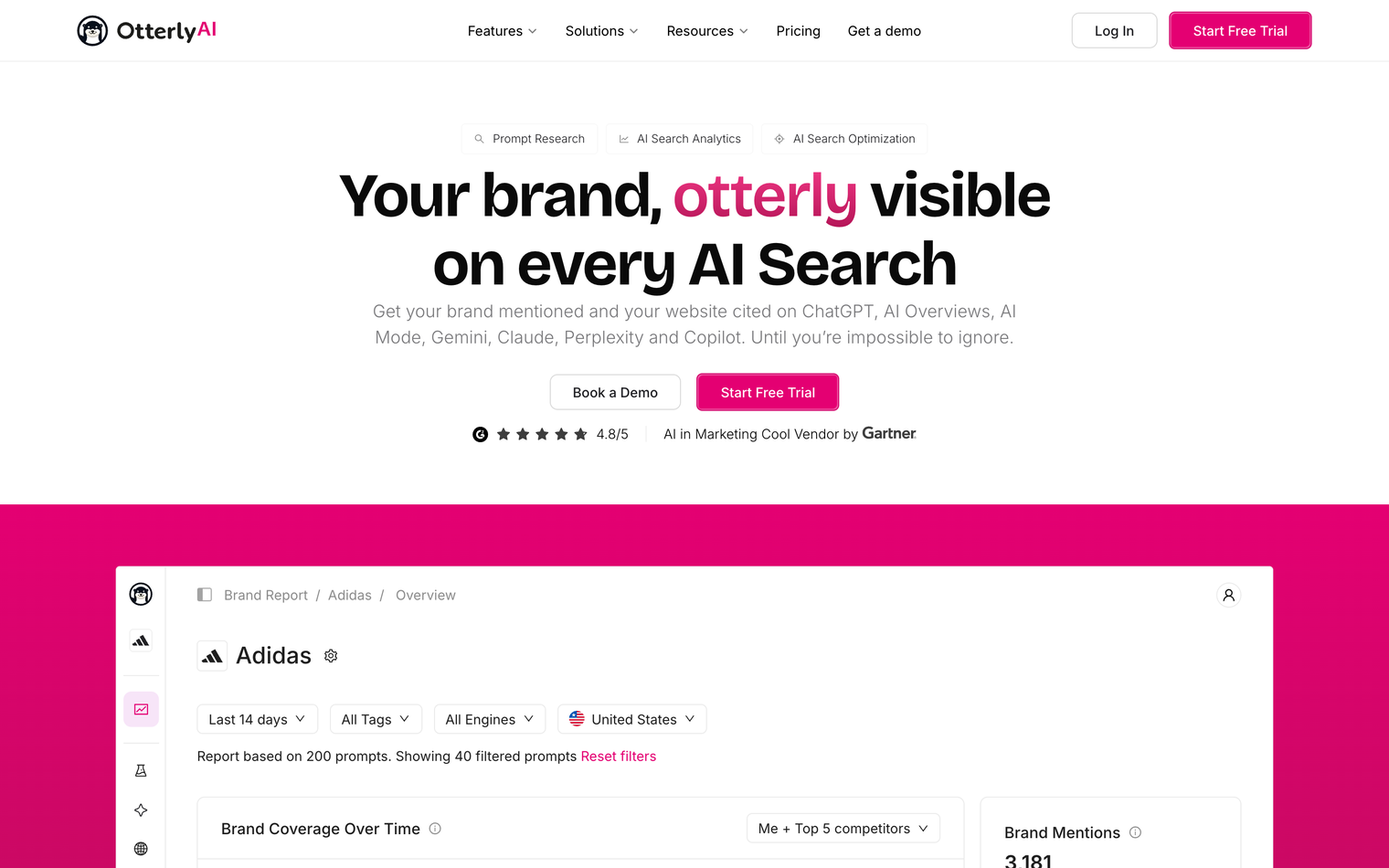
7. Otterly AI
Otterly AI is the affordable entry point among the dedicated monitoring tools.
Best for
Small businesses that want basic visibility tracking this week.
What it tracks
Brand mentions and link citations, with daily checks. Plans cover four of seven engines. Gemini, Claude and Google's conversational mode are extras.
Pricing
Otterly AI starts at $29 per month for the Lite plan with 15 prompts. The pricing page now shows 16. Standard is $189 and Premium is $489.
Limits
Not tested hands-on. Fifteen prompts is a sample, not a picture.
8. Rankscale AI
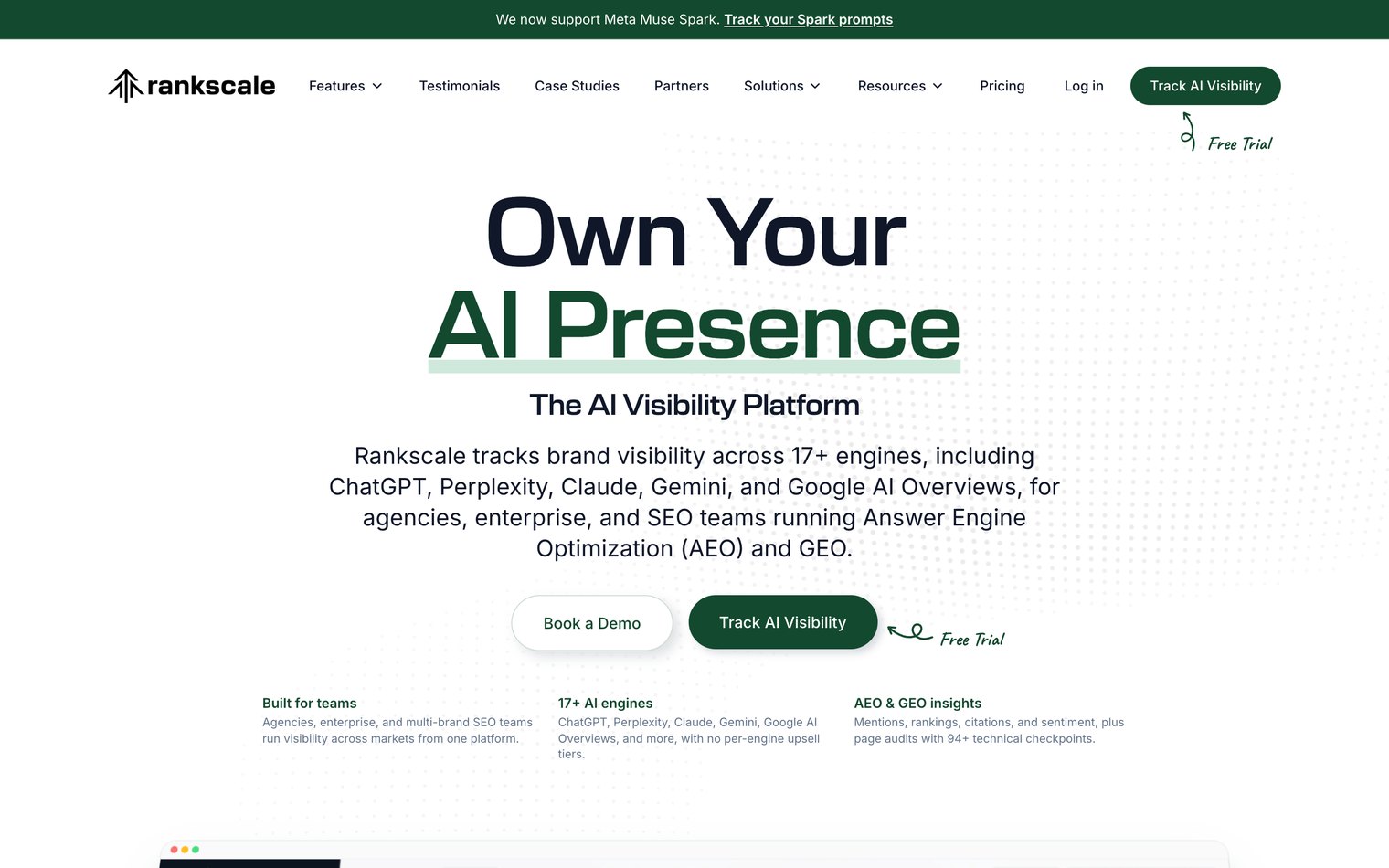
Rankscale AI has the lowest paid entry here, with pricing from about €20 per month.
Best for
Freelancers who want to test AI visibility tracking on a small budget, with wide AI platform coverage.
What it tracks
Visibility, citations and sentiment across more than 17 AI engines. Usage is metered in credits.
Pricing
Essentials is about $20 per month, yearly only, with 120 credits. Pro is $99 with 1,200 credits.
Limits
Not tested hands-on. Credits run out quickly when you track many engines.
9. LLMrefs
LLMrefs focuses on AI keyword tracking and competitor comparisons. It is a low-cost option for solo marketers and startups.
Best for
Small teams that think in keywords, not prompts.
What it tracks
Mentions, sources and fan-out queries across nine engines, with geo-targeting in more than 50 countries.
Pricing
LLMrefs is priced at $79 per month for one plan with 500 prompts and unlimited seats.
Limits
Not tested hands-on. One plan means little room to scale down.
10. Rankability
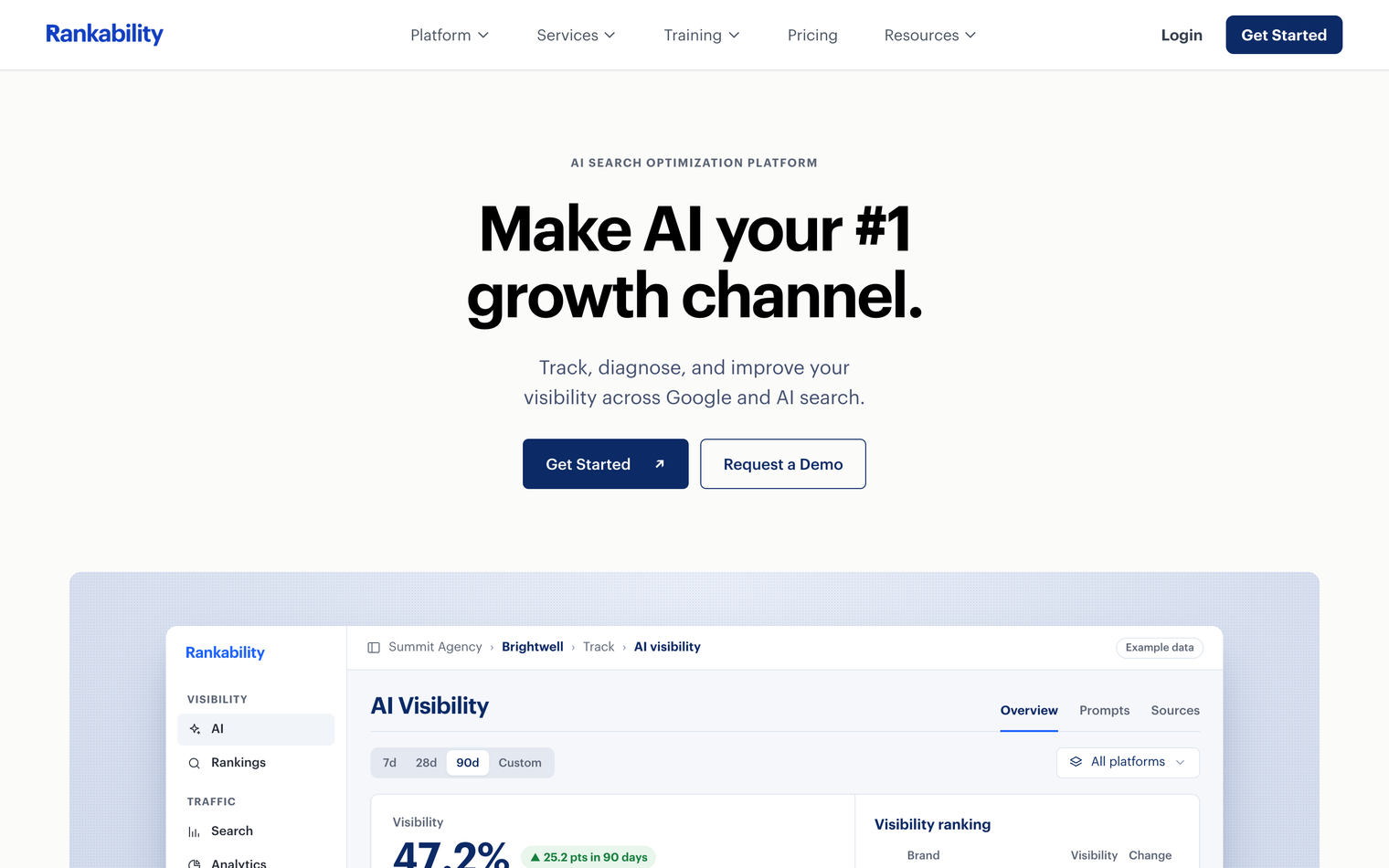
Rankability pairs content optimization with an AI visibility tracker. It is best for agencies needing SEO and AI visibility in one platform.
Best for
Agencies that report on both channels for clients.
What it tracks
Mentions and citations across 11 platforms, checked daily, with one allowance shared across client workspaces.
Pricing
Rankability's pricing starts at $97 per month for the Starter plan, with 100 tracked AI queries. Growth is $297 and Pro is $497.
Limits
Not tested hands-on.
11. AthenaHQ
AthenaHQ is best for mid-market brands needing deeper analytics than the entry tools offer.
Best for
In-house teams that want recommendations as well as reports.
What it tracks
Mentions, citations and sentiment across 11 engines on the Starter plan, with action suggestions.
Pricing
AthenaHQ Starter is $295 per month with 3,600 credits. A free Essential plan includes 300 credits.
Limits
Not tested hands-on. The step from free to $295 is steep.
12. Google Search Console
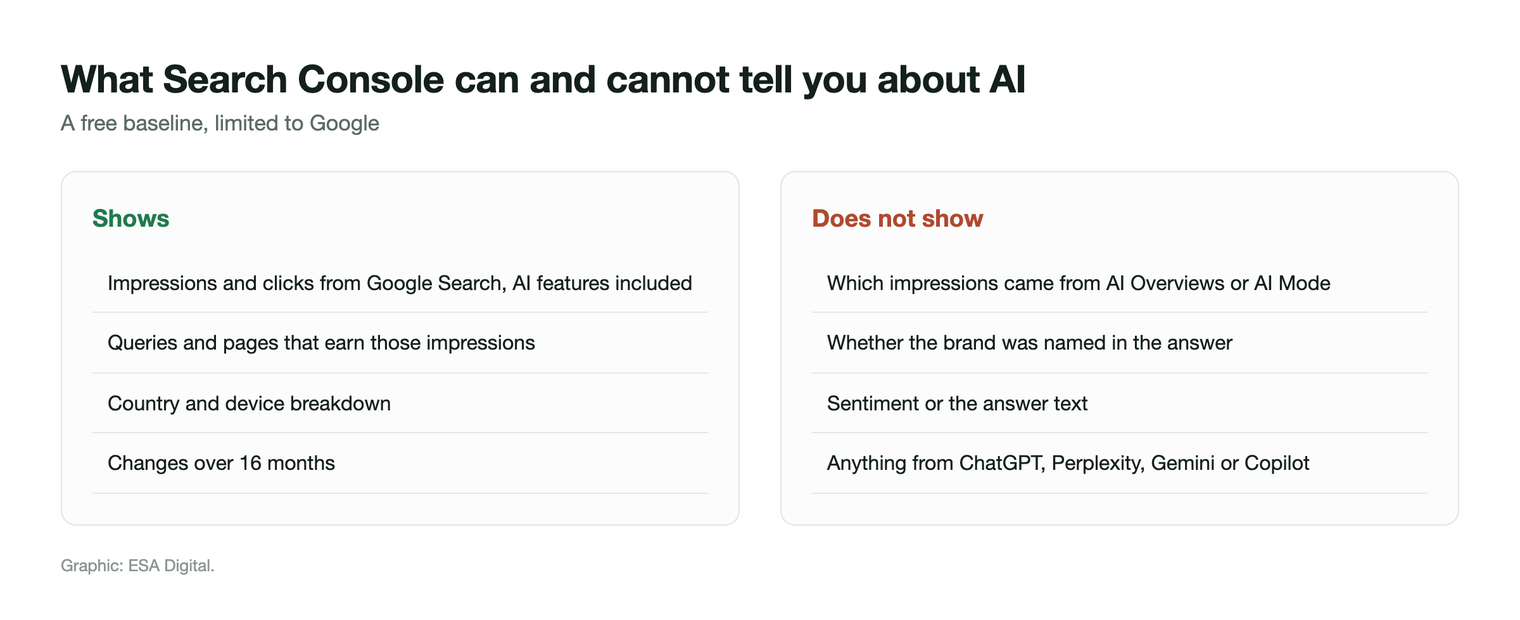
Search Console is not an AI visibility tool. It is the free baseline every site should read first.
Best for
Everyone, before paying for anything.
What it shows
Impressions and clicks from Google Search, including its AI features. The report does not separate them, and it shows no data for ChatGPT or Perplexity.
Limits
A rise in impressions with flat clicks is often the only visible trace of AI answers.
Why AI visibility tools disagree with each other
This is the section most comparisons skip. It matters more than any feature table.
Personalization hides part of the picture
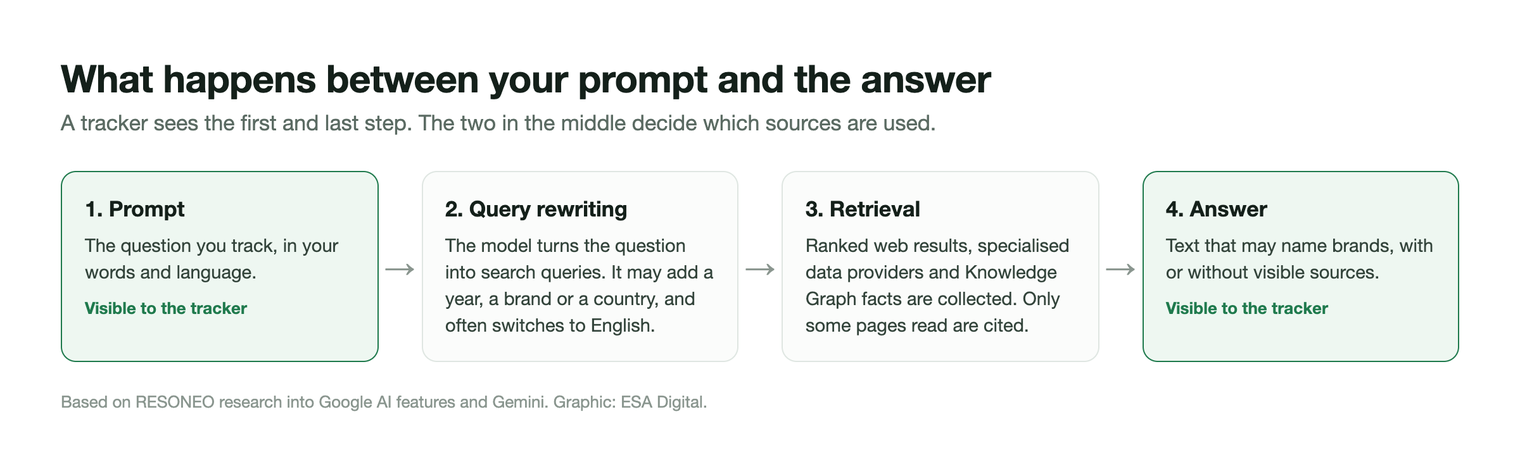
According to RESONEO's analysis, the web layer of Google AI Mode is the same for logged-in and logged-out users. A personal layer is then added on top for signed-in users. A tracker runs without an account, so it sees only the web layer.
Many AI answers show no sources
In an analysis of public Gemini conversations, about 43% of answers that used search showed no sources at all. Citation analysis cannot count what is not displayed. Part of your influence is invisible to every tool.
AI rewrites the question before it searches
The same study found that Gemini turns a question into search queries. It added a year the user never typed in 37% of queries. More than half of non-English conversations that used search included an English query. The prompt you track is not the query that fetches the sources.
Index tools and prompt tools measure different things
An index tool such as Brand Radar reports what appears across millions of prompts it chose. A prompt tool such as Peec AI reports what appears for the prompts you chose. Neither is wrong. They answer different questions, which is why two search visibility tools can report different numbers for the same brand in the same week.
Scraping is getting harder
Google has tightened bot detection and removed the option to load 100 results per page. Data from any AI search monitoring tools that rely on scraping search engines can be distorted. Treat small week-to-week moves as noise. Tracking visibility by scraping will only get harder.
Dedicated tracker or traditional SEO suite?
AI brand visibility tools fall into two groups, and the choice shapes everything else.
The case for a suite
A traditional SEO suite such as Ahrefs, Semrush or SE Ranking puts AI visibility data next to rankings, backlinks and keyword research. You can see in one place whether a page that lost clicks still earns AI brand mentions. For most in-house teams, one SEO platform with added AI visibility features is enough to start.
SE Ranking is the clearest example. Its base plans already include a small prompt allowance, so a team can track AI visibility before paying for anything extra.
The case for a dedicated tool
Dedicated AI search monitoring tools such as Peec AI, Profound and Otterly AI go deeper. They offer more engines, more prompts and better reporting on AI generated answers. Teams that treat AI search as its own channel, with its own owner, usually outgrow a suite add-on within a year.
What we do
We run both. A suite gives us the category view and traditional search visibility. A dedicated prompt set gives us the questions a specific client cares about. If budget allows only one, we start with the suite the team already pays for.
How to choose the right AI visibility tool
Start with the engines your buyers use
Check where your category gets asked before you compare the best AI search products. B2B software buyers lean on ChatGPT. Consumer and local questions lean on Google AI. Pick a tool that covers those two first.
Match the tool to your stack
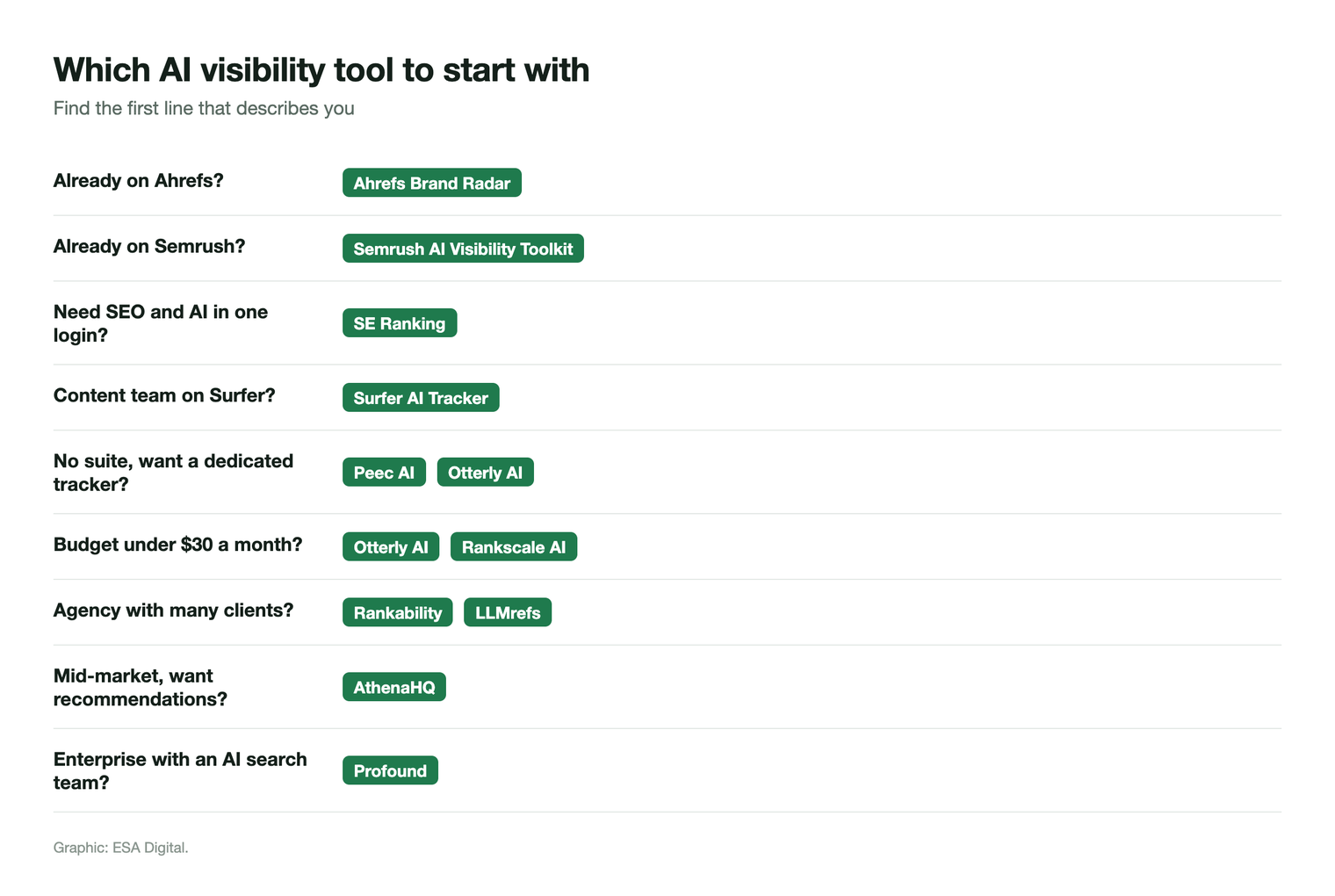
- On Ahrefs: start with Ahrefs Brand Radar.
- On Semrush: add the AI Visibility Toolkit.
- On neither: Peec AI or Otterly AI, or SE Ranking if you also need an SEO suite.
- Agency with many clients: Rankability or LLMrefs, where seats and workspaces are shared.
Budget by prompts, not by plan name
Work out the cost per tracked prompt per engine. A $29 plan with 15 prompts on four engines costs more per data point than a $95 plan with 50 prompts on three.
Run a two-week trial on real prompts
Use prompts from sales calls, not from a keyword list. Include your competitor names and your category in the buyer's language, and in every market you sell in.
What to do with the data: winning AI search
Visibility tracking is only useful if it changes what you publish. The best AI search programs we see treat the tool as a to-do list.
Fix what gets cited, not what gets counted
AI visibility tools identify which specific URLs are cited. Find the pages that AI answers mention for your category, and compare them with yours. In our test that pointed to YouTube for Google's surfaces.
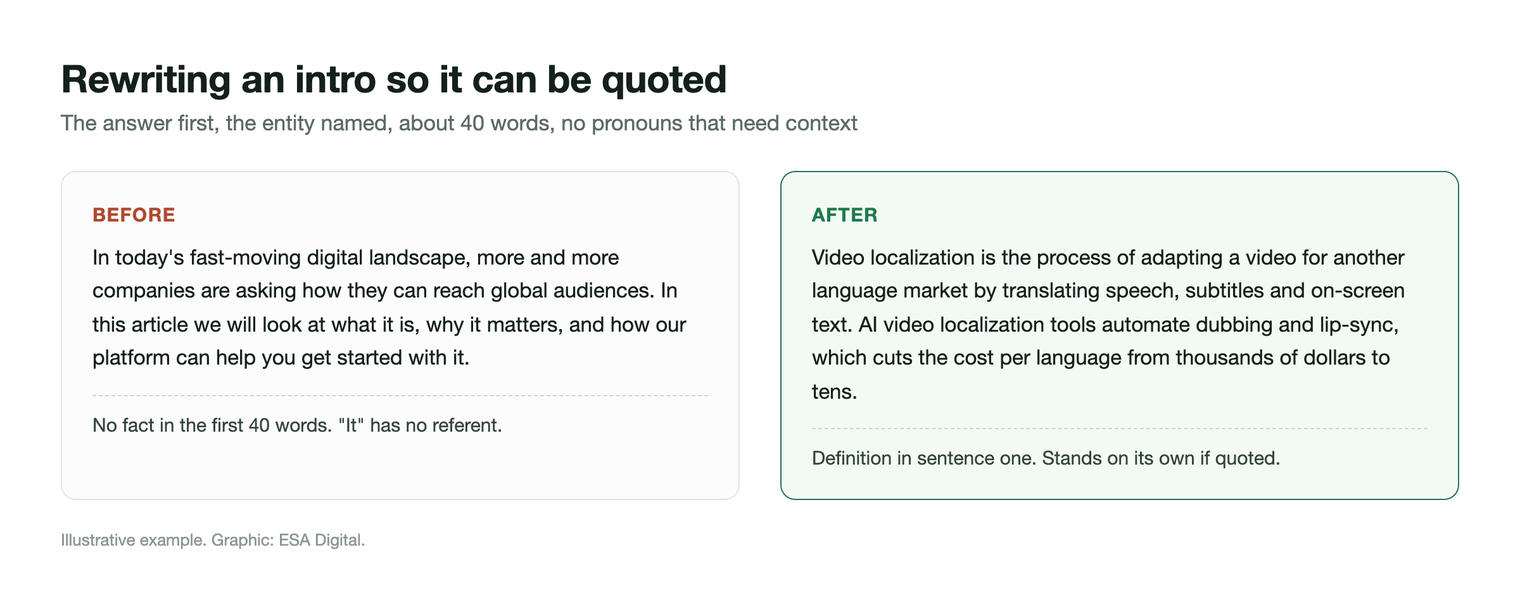
Write passages that can be quoted
Effective content must answer questions clearly to be cited. In the Gemini study, a third of cited passages began in the first tenth of the page, and the median cited passage was 43 words long. Put the answer first, in a short paragraph that makes sense on its own.
Earn mentions on other sites
Google's Knowledge Graph confirms some facts only when three separate sites agree. Ten pages on your own domain count as one. Brand visibility in AI answers depends on what independent sources say about you.
Keep ranking
Four to five of the seven sources in a typical AI Overview are first-page results. Content optimization for AI starts with the page ranking in the first place. For the full list of signals, see our guide to 155 AI ranking factors.
Frequently asked questions
What is the best AI visibility tool for small businesses?
Otterly AI at $29 per month or Rankscale AI at about $20 per month. Both give a small prompt set with daily checks, which is enough to see whether the brand appears at all in AI answers.
Is there a free AI visibility tool?
AthenaHQ has a free plan with 300 credits, Profound offers a seven-day trial, and paid Ahrefs plans include a few free prompts. Google Search Console is free but covers Google only.
How many prompts should I track?
Start with 25 to 50 prompts across two or three engines. Cover your category, your main competitors, and the problems your product solves.
How often does AI visibility change?
Daily. AI answers vary between runs of the same prompt, so look at trends over four weeks or more.
Which AI search visibility tool covers the most engines?
Rankscale AI lists more than 17 engines, and Rankability and AthenaHQ list 11 each. Profound offers up to 10 on its enterprise plan. Coverage on paper is not the same as coverage on your plan, so check what the entry tier includes.
What is the difference between AI visibility monitoring and rank tracking?
Traditional rank tracking records one position for one keyword. AI visibility monitoring samples many answers and reports how often a brand appears and how it is described. The first is a position. The second is a rate.
Do brand visibility tools show why a competitor is cited?
Partly. Brand visibility tools show which competitor pages are cited and for which prompts. Working out why takes a person who reads those pages and compares them with yours.
Do I still need traditional SEO?
Yes. AI search engines read the same ranked pages that traditional SEO puts on page one. The two are one program, measured with two sets of tools.
Can an agency do this instead of a tool?
An agency uses the same tools. The difference is who acts on the data. If nobody on your team has time to turn a citation report into content and outreach, that is the gap to fill.
The bottom line
There is no single best AI visibility tool. There is a best fit for your stack, your budget and the AI search platforms your buyers use. Brand visibility in AI search is now a measurable channel, and the visibility tools in this list are good enough to start measuring it today.
Search visibility tools change fast, and so do their prices. Pick one tool, track real prompts for a month, and judge it on whether it changed a decision. If you want a second opinion on the data, book a discovery call or read how our GEO services work.
Method note. Brand Radar data was pulled on November 13, 2026 and reflects estimated mentions in the Ahrefs index. Google system details come from RESONEO's published research on Google's internal schemas and from public trial exhibits. Prices are from each vendor's pricing page on the same date.
