

Other cookies are configurable.
Answer Engine Optimization (AEO): What It Is, What It Does to Your Business and How to Do It


Answer engine optimization (AEO) is the practice of getting your content chosen as the answer when a search engine replies to the question itself. It covers featured snippets, Google AI Overviews, Google AI Mode and voice assistants. The goal is to be the cited source, not just a ranked link.
That is the definition. The rest of this guide covers what most definitions skip: what AI search does to traffic and revenue, how answer engines pick their sources, and the eight steps we use at ESA Digital to get SaaS and app brands into AI generated answers. It is written for founders and digital marketing leads who need a marketing strategy, not a glossary.
Key takeaways
- Answer engine optimization is about winning the answer inside search. Generative engine optimization (GEO) is about being named by chat assistants such as ChatGPT. The two overlap, and most brands need both.
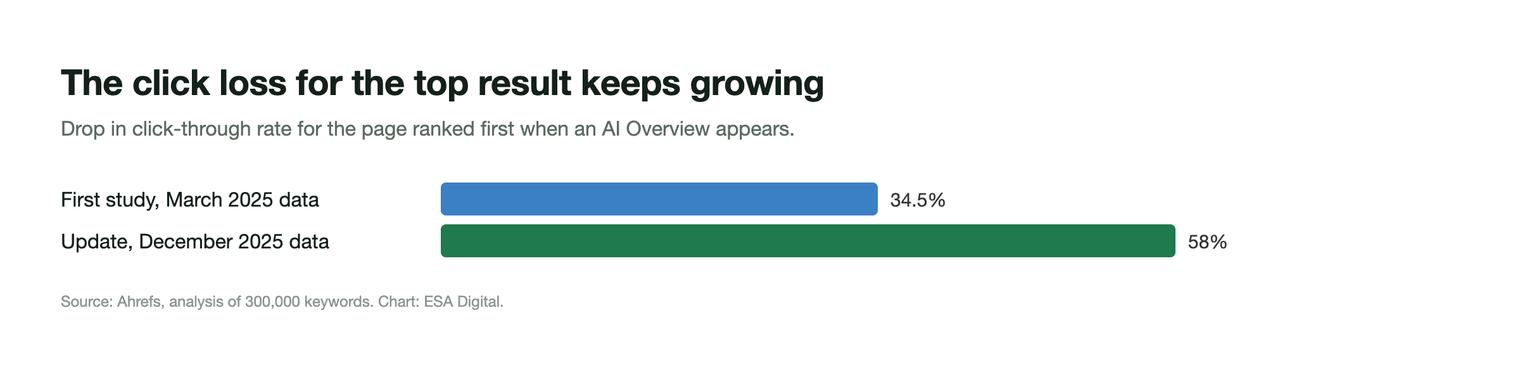
- AI Overviews cut clicks to the top organic result by 58%, according to Ahrefs. The same rankings now bring fewer visits.
- AI powered answer engines quote passages, not pages. A cited passage is about 43 words long and usually sits in the first half of the text.
- Ranking still matters. Most cited sources are found through regular search before any AI summary is written.
- You measure AEO with citations, brand mentions and share of voice. Clicks alone will mislead you.
What is answer engine optimization?
Answer engine optimization (AEO) is the work of making your content the source an answer engine quotes. You will also see it called AI search optimization. A classic search engine returns a list of pages and lets the user choose. An answer engine reads those pages, writes a reply and shows it above everything else. Your page either feeds that reply or it does not.
This changes the unit of competition. In traditional search engines you compete for a position on a page of ten blue links. In answer engines you compete for a sentence. One short passage from your page is lifted by AI systems, rephrased and shown to the user, sometimes with a link and sometimes without one.
What counts as an answer engine
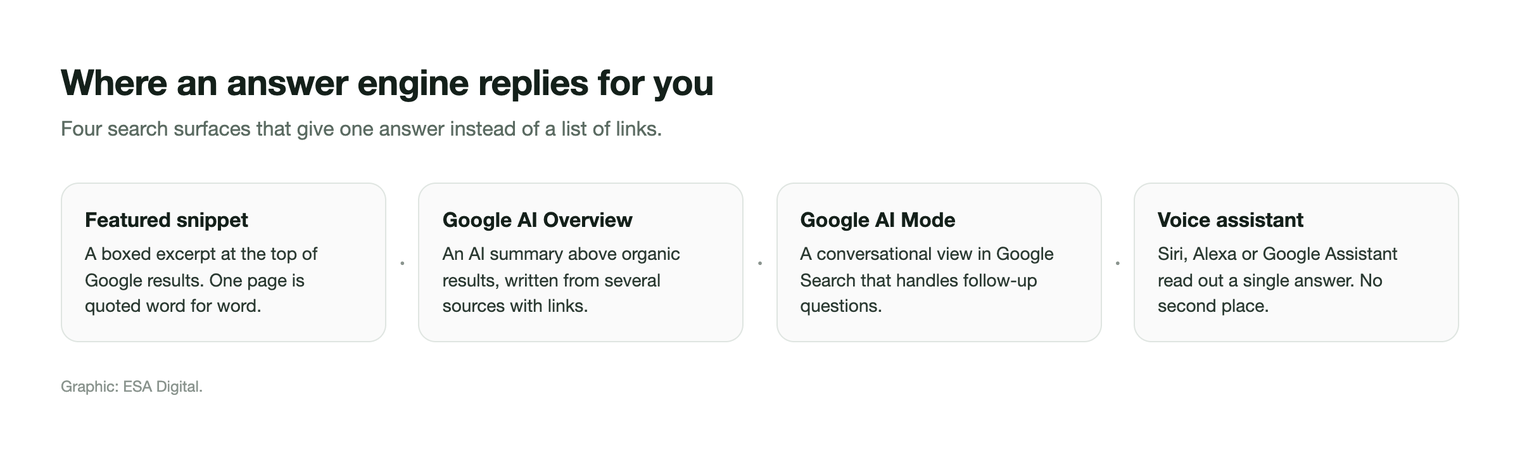
We use the term for any search surface that responds with direct answers instead of a list:
- Featured snippets. The boxed excerpt at the top of Google search results. This is the oldest answer format and it still works.
- Google AI Overviews. AI generated summaries that appear above organic search results for a growing share of search queries.
- Google AI Mode. A full conversational view inside Google Search that handles follow up questions.
- Voice assistants. Siri, Alexa and Google Assistant read out one answer. Voice search results have no second place.
- Other answer engines. Bing Copilot Search and Perplexity work on the same principle: retrieve, summarise, cite.
Where the term comes from
Answer engine optimization is older than generative AI. The term appeared around 2017 and 2018, when featured snippets and voice search first pushed marketers to write for a single spoken or boxed answer. Large language models changed the scale. Modern answer engines and AI powered search engines no longer copy a paragraph. They compose a new one from several sources, which makes the selection process harder to see and harder to influence.
AEO vs SEO vs GEO: what is the difference?
The three terms describe three different places where a buyer can meet your brand, and each reflects a shift in user behavior. The market often uses AEO and GEO as synonyms, and you will find guides that define them the other way round. We separate them because the work and the measurement differ.
| Traditional SEO | AEO | GEO | |
|---|---|---|---|
| Where it happens | Search engine results pages | Answer boxes inside search: featured snippets, AI Overviews, AI Mode, voice | Chat assistants: ChatGPT, Claude, Gemini, Perplexity |
| What you win | A ranking position | The cited answer | A brand mention or recommendation |
| Unit of competition | Page | Passage | Entity and its facts |
| Main levers | Relevance, links, technical health | Answer-first passages, structure, rankings on sub-questions | Third-party mentions, consistent facts, original data |
| How you measure | Positions, organic traffic | Citations, impressions in AI features | Mentions, share of voice |
What is AEO vs SEO?
Search engine optimization aims to rank a page as high as possible in traditional search results. Answer engine optimization aims to have that page quoted in the answer shown above those results. SEO is measured in positions and clicks. AEO is measured in citations and mentions.
The two are not rivals. Traditional SEO is the entry ticket, because answer engines mostly quote pages that regular search has already retrieved. AEO is what you do with a page once it can be found: you make its best passage easy to lift.
AEO vs GEO
AEO works inside search. The user typed a query into Google, and one of Google's AI features answered it. Generative engine optimization works inside AI platforms that are not search engines at heart. A person asks ChatGPT which tool to buy, and the model replies from its training data, from a live web search, or from both.
The practical difference is where the answer comes from. In AI Overviews the sources are mostly pages from Google's own index. In AI tools such as ChatGPT a large part of the reply comes from what the model learned about your brand across the web: reviews, comparisons, forum threads and news. That is why GEO leans on digital PR and brand mentions across AI platforms, while AEO leans on page structure and rankings.
Do you need three separate strategies?
No. You need one content strategy with three checks, and one search optimization team to run them. Can the page be found (SEO)? Can a passage be quoted (AEO)? Is the brand described the same way on other sites (GEO)? In our projects one team runs all three, because a single article can earn a ranking, an AI Overview citation and a ChatGPT mention at once.
What AEO means for your business
Most guides to answer engine optimization (AEO) stop at tactics. For a founder or a head of marketing the first question is different: what does this do to the pipeline? Three things change.
The same rankings bring fewer clicks
AI driven search has produced a sharp rise in zero-click searches. The user reads the direct answers on the results page and leaves.
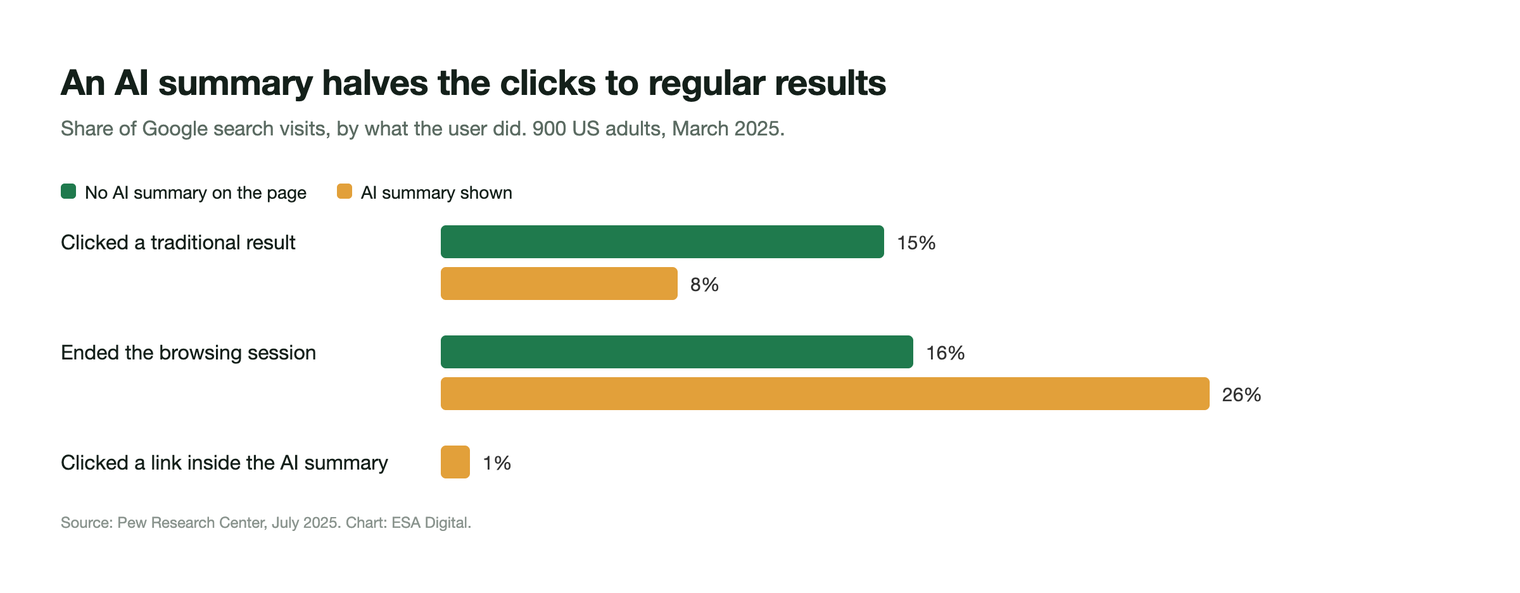
- Pew Research Center tracked the browsing of 900 US adults in March 2025. When an AI summary appeared, users clicked a traditional result in 8% of visits, against 15% without one. Only 1% clicked a link inside the summary.
- Ahrefs compared 300,000 keywords. In its first study AI Overviews lowered the click-through rate of the top result by 34.5%. The update, on December 2025 data, puts the drop at 58%.
- Pew again, in a February 2026 survey of 5,119 adults: 60% of Americans say they read AI summaries at the top of search results.
If AI generated summaries sit above your pages and your reporting shows stable search visibility and falling website traffic, this is the likely cause. The demand did not disappear. It is being served on the results page.
The visits that remain are worth more
A person who clicks through after reading an AI answer already knows the basics. Semrush studied more than 500 digital marketing topics across traditional and AI search and estimated that an average AI search visitor is worth 4.4 times a traditional organic search visitor, based on conversion rates.
Our own data points the same way. Across our client projects, AI referral traffic from ChatGPT converts 1.5 to 2 times better than visits from organic search. The volume is still small, but these visitors arrive later in the buying journey.
Your brand is judged before the click
This is the part of AI driven search that matters most for B2B. A buyer asks which consent platform or which video translation tool to choose, and the answer names three brands. If yours is not one of them, you are out of the shortlist before your site is opened. Your content appears nowhere in the decision. No ranking report will show that loss.
The reverse also holds. A brand that AI cites in the answer gets a recommendation the user did not have to search for. For a new product in a crowded category this is the cheapest route to consideration we know of.
Who is affected most
- Content-led SaaS. Blogs that lived on informational queries lose the most clicks, because those queries trigger AI Overviews most often.
- Apps and consumer subscriptions. "Best app for" questions are now answered with a list of names. The list is the new first page.
- Companies entering a new market. AI platforms have little local data about you, so early, well-structured content gets picked up fast. Our Polish case below is an example.
Paid search does not close the gap. Google Ads can buy a place on the page, but it cannot buy a place inside the answer.
How answer engine optimization works: how sources get chosen
Tactics make sense only when you know how answer engines select what to quote. The most detailed public picture comes from RESONEO's research into AI Overviews and AI Mode, which analysed how Google's AI features retrieve and cite pages. These are research findings, not official Google statements. They match what we observe in client data.
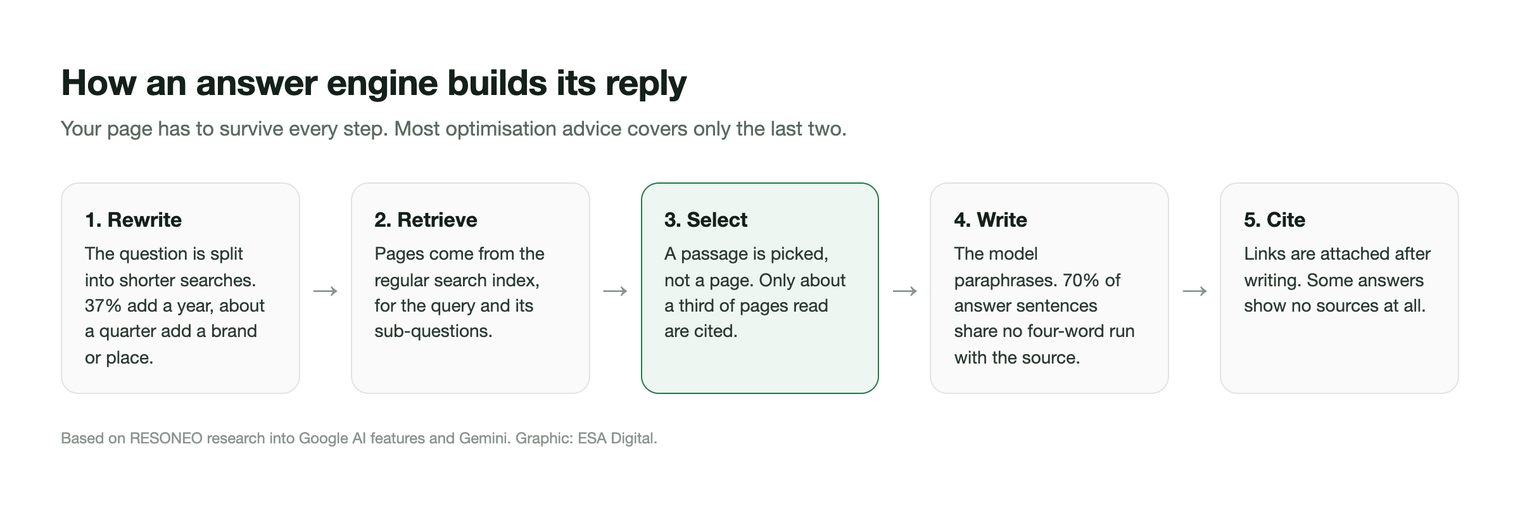
The question is rewritten first
AI engines rarely search for the user's query as typed. They break the question into several shorter searches, a process known as query fan-out. According to RESONEO, 84% of these searches are compressed into keywords, 37% add a year the user never mentioned, and about one in four adds a brand, a model or a place.
For you this means a page must rank for the sub-questions behind the user's query, not only for the head term. A guide on pricing models may be retrieved for "usage based pricing examples 2026" even though nobody typed that.
Pages are retrieved from regular search
In Google, the AI layer sits on top of the classic index, and most answer engines work the same way. In one query RESONEO examined, four of the seven AI Overview sources were ordinary first-page links, and five of seven in the French version.
Ranking helps a lot and guarantees nothing. A page on position 14 with a clean answer can be cited over a page on position 2 that buries it.
A passage is picked, not a page
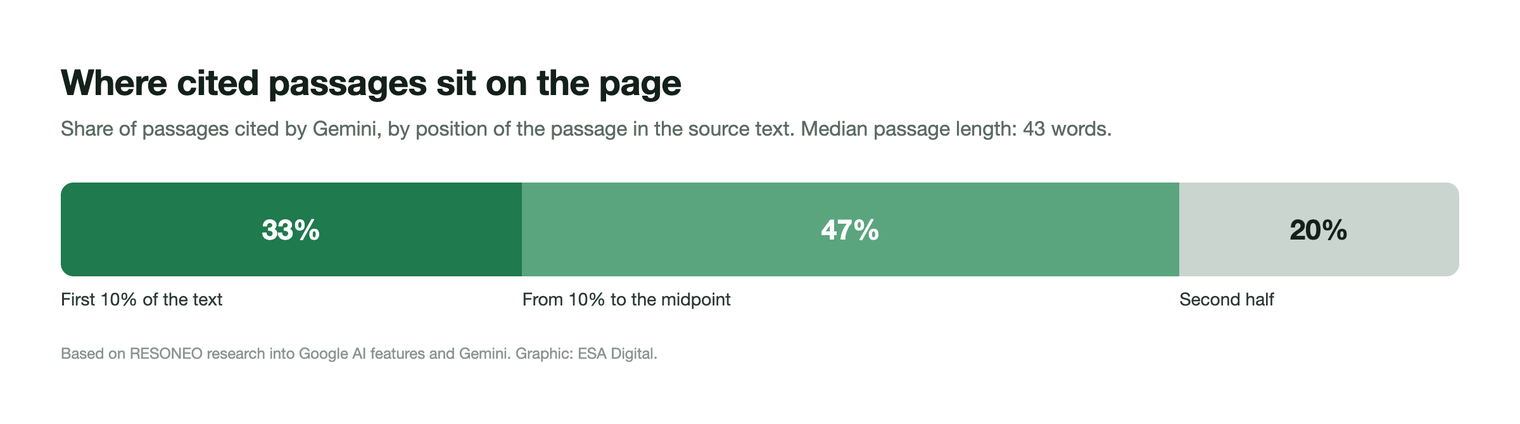
This is the finding we use most. Among the passages Gemini cited:
- the median length was 43 words;
- 33% started in the first tenth of the text and 80% in the first half;
- only about a third of the pages that were read ended up cited.
AI models also rewrite what they take. In 70% of answer sentences there was no four-word overlap with the source. So the aim is not to have your wording copied. It is to have your fact, in a self-contained passage, close to the top.
Facts are checked across sites
AI systems try to reduce errors by preferring facts that several independent sources agree on. RESONEO describes a triangulation across three hosts, where ten pages on one site count as one. A claim that lives only on your domain is weak evidence. The same claim on your pages, a review platform and an industry publication is strong.
This is also where inconsistency hurts. If your founding year, pricing or product category differs between your site, your Crunchbase page and your G2 profile, AI platforms have conflicting training data and may merge you with another company or leave you out.
This is a standing part of our work. For every client we align the facts in three places: on the client's own pages, in directories and company profiles, and in external sources such as reviews, comparisons and media. The description of the brand has to match wherever an answer engine looks.
Each engine has its own sources
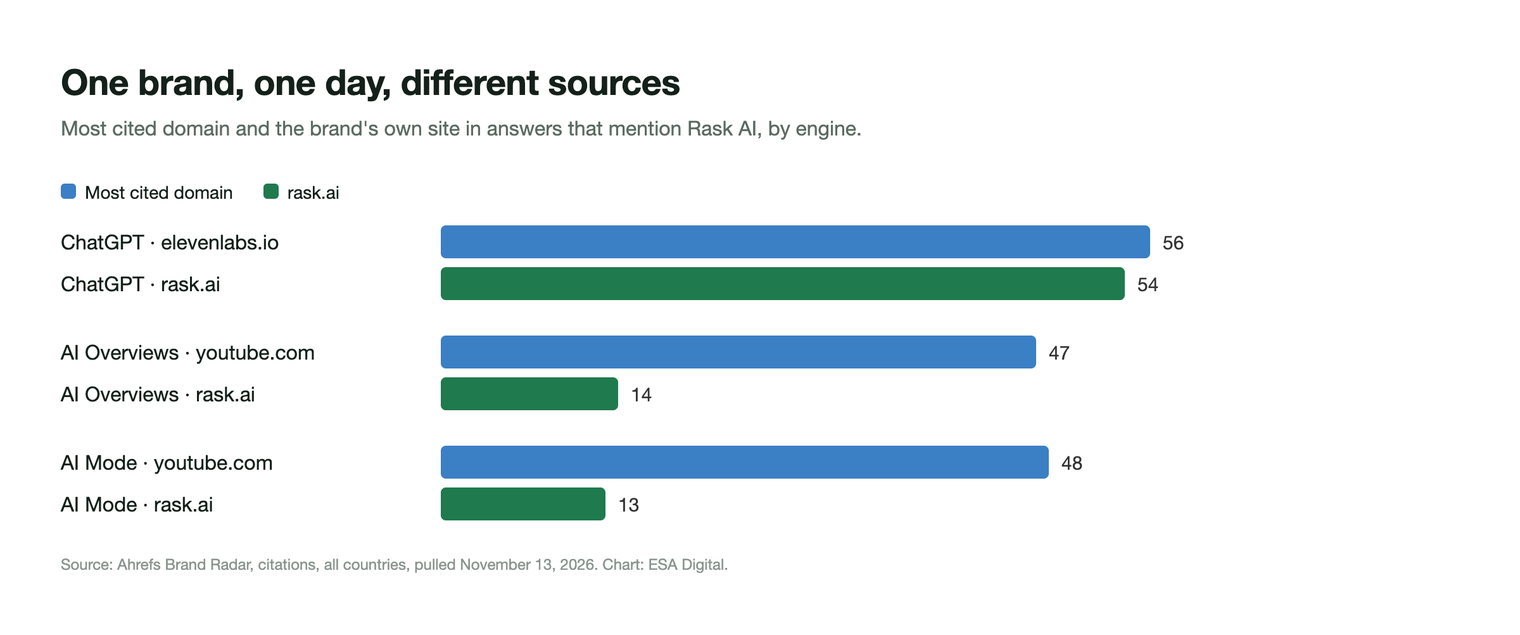
Do not assume one result set for all answer engines. We tracked Rask AI, an AI video translation product, in Ahrefs Brand Radar on a single day. In ChatGPT the brand's own site was cited 54 times, almost level with the category leader. In Google AI Overviews the most cited domain was YouTube with 47 citations, and rask.ai had 14.
Same brand, same day, different evidence across AI engines. Google's AI features lean on video and on pages that already rank. ChatGPT leaned on product pages. An AEO strategy has to be checked per engine, including the AI tools your buyers use at work.
What gets cited for "answer engine optimization" itself
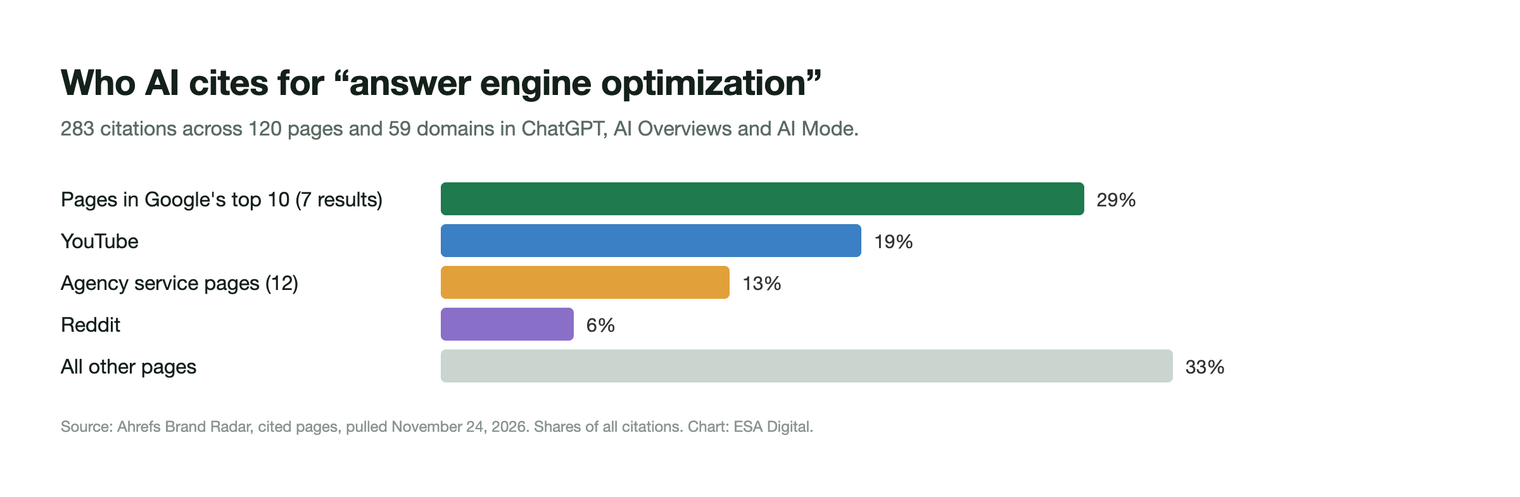
We ran the same check on the topic of this guide. On 24 November 2026 we exported from Ahrefs Brand Radar every page cited in ChatGPT, AI Overviews and AI Mode for prompts about answer engine optimization: 120 pages on 59 domains, 283 citations in total.
- The Google top 10 is a minority. The seven organic results on the first page, among them Forbes, HubSpot, PwC and Coursera, collected 29% of the citations. The other 71% went to pages outside it.
- YouTube is the most cited domain, with 53 citations, about one in five. Reddit threads add 18 more.
- Service pages get quoted. Twelve agency landing pages earned 38 citations. One of them, on a site with a Domain Rating of 56, was cited as often as a guide by Neil Patel.
- Authority is not a gate. 21 of the cited pages sit on domains rated below 60.
The lesson for a smaller brand is practical. You may not outrank Forbes for a head term this year, but answer engines read far beyond the first page, and they will quote a focused page or a clear six-minute video.
How to do answer engine optimization: AEO best practices in 8 steps
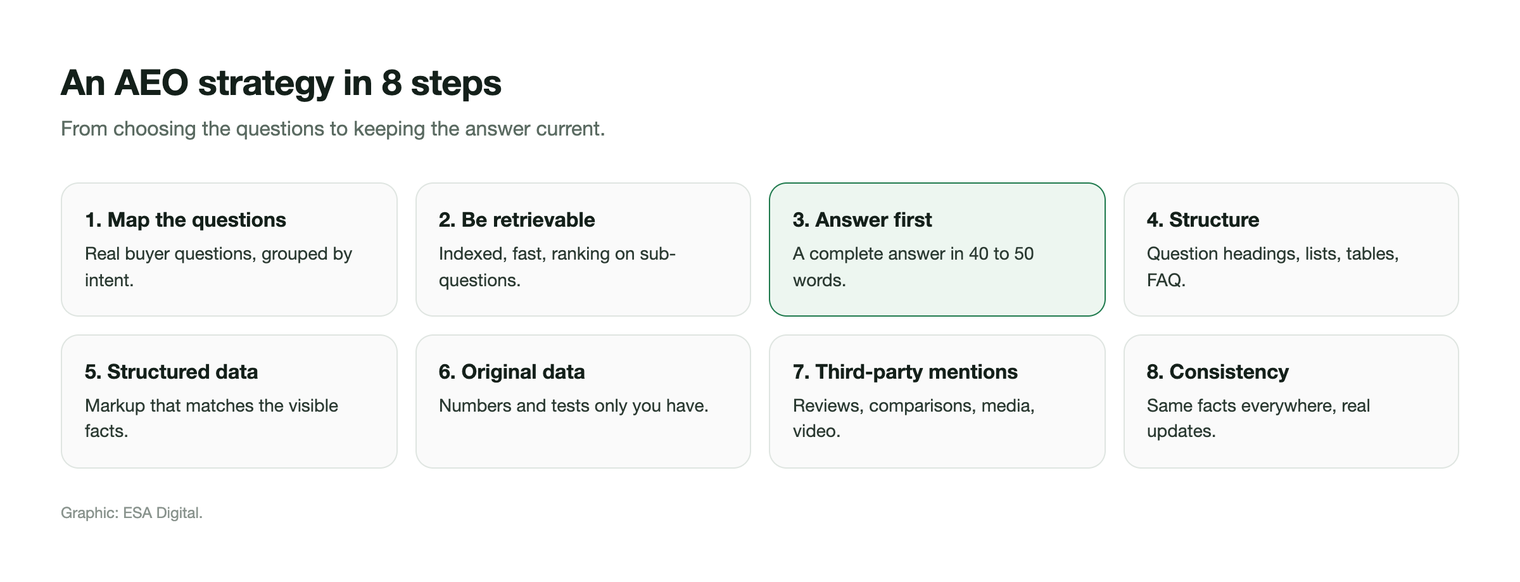
An AEO strategy is a repeatable plan for getting your pages quoted in AI generated answers, and it belongs inside your wider digital marketing strategy: choose the questions, earn retrieval, shape the passage, back it with evidence and measure the result. Below is the sequence we follow. It works for a new page and for existing content.
1. Map the questions your buyers ask
Start with keyword research, then go one level deeper. For each topic collect the real questions: People Also Ask boxes, sales call notes, support tickets, Reddit threads and the follow up questions AI Mode suggests. Group them by search intent and by stage of the journey.
Then check which of those questions already trigger a reply from answer engines. There is little point in optimizing content for a query where Google shows ten links and nothing else. Prioritise the questions where answer engines already give direct answers.
2. Make sure the page can be retrieved
Before you tune a passage, confirm the basics of traditional SEO. The page is indexed. It loads fast, because site speed still decides whether a crawler finishes the job. It ranks, or can rank, for the head term and the sub-questions. Internal links point to it with descriptive anchors.
AI agents and crawlers also need access. Check that robots.txt does not block the bots you want. Note that blocking Google-Extended does not remove a site from AI Overviews. The setting that does is the Search generative AI control in Search Console, and it removes the traffic with it.
3. Put the direct answer first
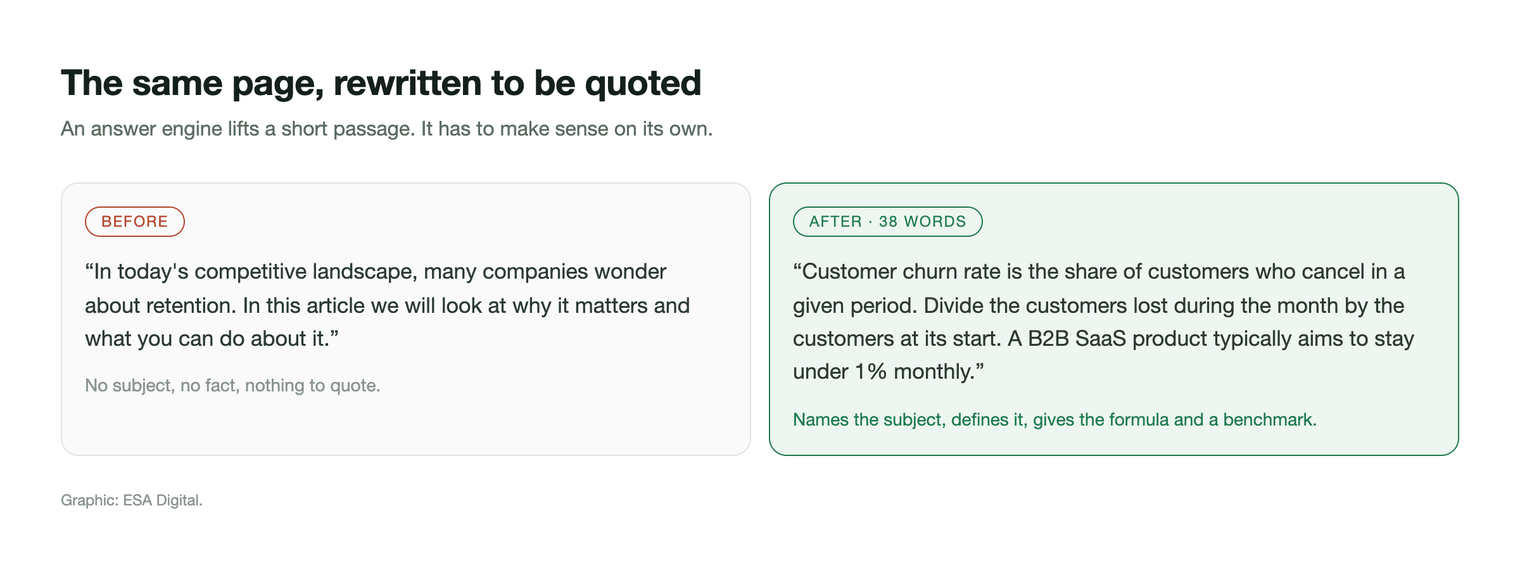
Open every page and every major section with a complete answer of 40 to 50 words. Name the subject in the sentence so it still makes sense when lifted out of context. Then expand.
Compare two openings for a page about churn:
- Weak: "In today's competitive landscape, many companies wonder about retention."
- Strong: "Customer churn rate is the share of customers who cancel in a given period. Divide the customers lost during the month by the customers at its start. A B2B SaaS product typically aims to stay under 1% monthly."
The second can be quoted as it stands. The first cannot.
4. Structure the page for extraction
Write headings as the questions people ask. Keep one idea per paragraph. Use bullet points for lists of options, numbered steps for processes and tables for comparisons. Add a short FAQ block for the questions that do not deserve a full section.
This structure serves human readers first. A person scanning on a phone and a model selecting a passage for AI generated answers want the same thing: the answer, clearly marked, without a preamble.
5. Add structured data, and be honest about what it does
Schema markup such as Article, FAQPage, Organization and Product helps a search engine understand what a page is about and who published it. Structured data feeds Google's Knowledge Graph, and the Knowledge Graph feeds answers.
It is not a switch. RESONEO's analysis concludes that schema.org markup does not influence AI Overviews directly. What matters is that the facts in your markup match the visible text and match what other sites say. Use structured data to remove ambiguity, not as a trick.
6. Bring something worth citing
AI systems and the answer engines built on them prefer original, verifiable information because it lowers the risk of a wrong answer. Publish what only you have: product usage numbers, benchmarks, test results, pricing you verified yourself, a named expert's view. State the method and the date.
A page that restates the top ten results gives a model no reason to choose it. A page with one new number often gets cited for that number alone.
7. Earn mentions on other sites
Third-party mentions are how AI systems verify that a brand is real and relevant. Aim for the places answer engines already read: independent comparison articles, review platforms, industry media, YouTube and community threads.
In our fitness app project we tracked each placement. In one month a third of new placements were picked up by at least one AI model within six days of going live. A citation can arrive much faster than a ranking.
8. Keep facts consistent and current
Audit how your company is described across the web: name, category, founding year, pricing, feature list. Fix the profiles you control. Then keep your own pages current with a visible update date, the same date in the markup, and a real change in content. A new date on an unchanged page is a risk, not a win.
How we run AEO for clients
ESA Digital is a digital marketing agency focused on SEO and generative engine optimization for SaaS, app and AI companies. Answer engine optimization services are part of every engagement, because we have stopped seeing projects where organic growth and AI search visibility can be planned apart. This is how the work is organised.
Our process
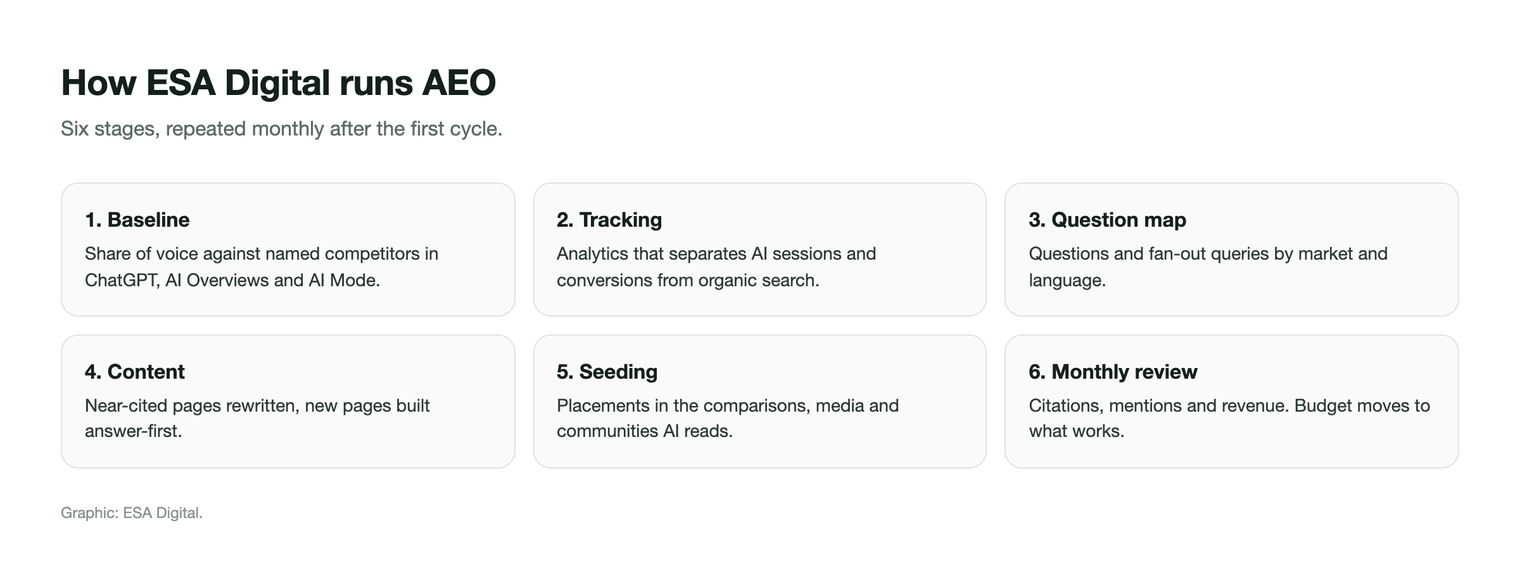
- Baseline. We measure share of voice across AI platforms, in ChatGPT, Google AI Overviews and Google AI Mode against your named competitors, and list which of your pages are cited and for what.
- Tracking. We set up Google Analytics so that sessions and conversions from AI platforms are reported apart from organic search.
- Question map. We build the list of questions and fan-out queries your target audience puts to answer engines, by market and language.
- Content. We start by optimizing content that is close to being cited, then brief new pages, each built answer-first.
- Seeding. We place the brand in the comparison articles, publications and communities that AI answer engines and other AI tools read.
- Monthly review. We report citations, mentions and revenue, and move budget to what works.
Case: a consent management platform enters Poland
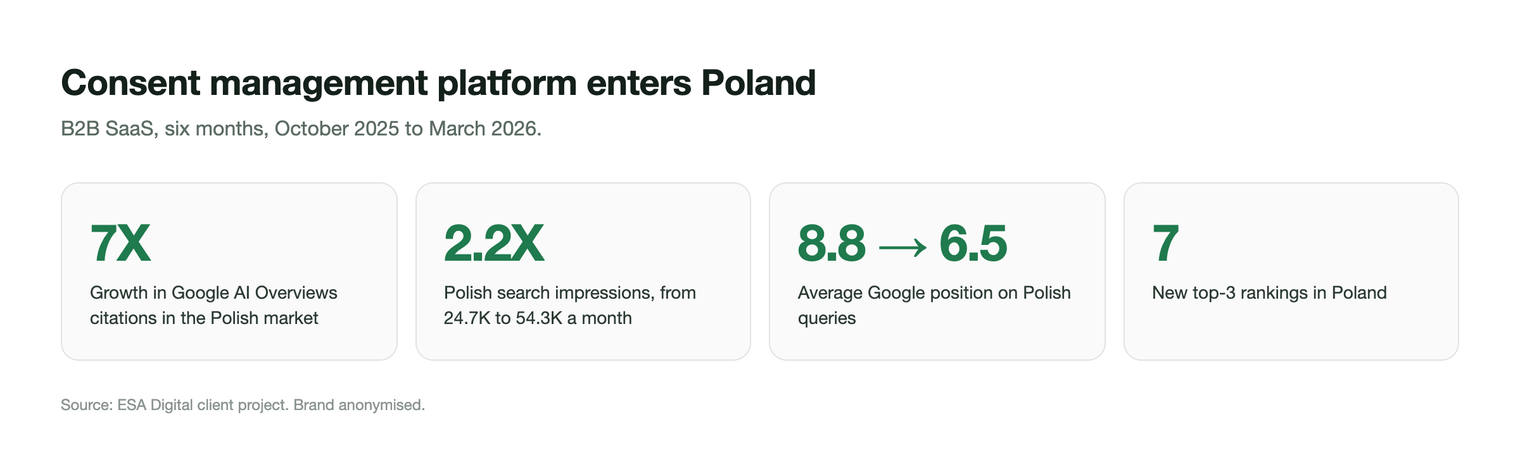
A global consent management platform had strong authority but no Polish pages and almost no presence in Polish AI search and no content for its Polish target audience. Over six months we mapped about 55 Polish keywords, set up AI traffic tracking and produced six localised pages with question-led headings and FAQ markup.
- Citations in Google AI Overviews in Poland grew 7X.
- Polish search impressions grew from 24.7K to 54.3K a month.
- Average position moved from 8.8 to 6.5, with 7 new top-3 rankings.
Read the full consent management case study.
Case: a fitness app wins citations with its blog
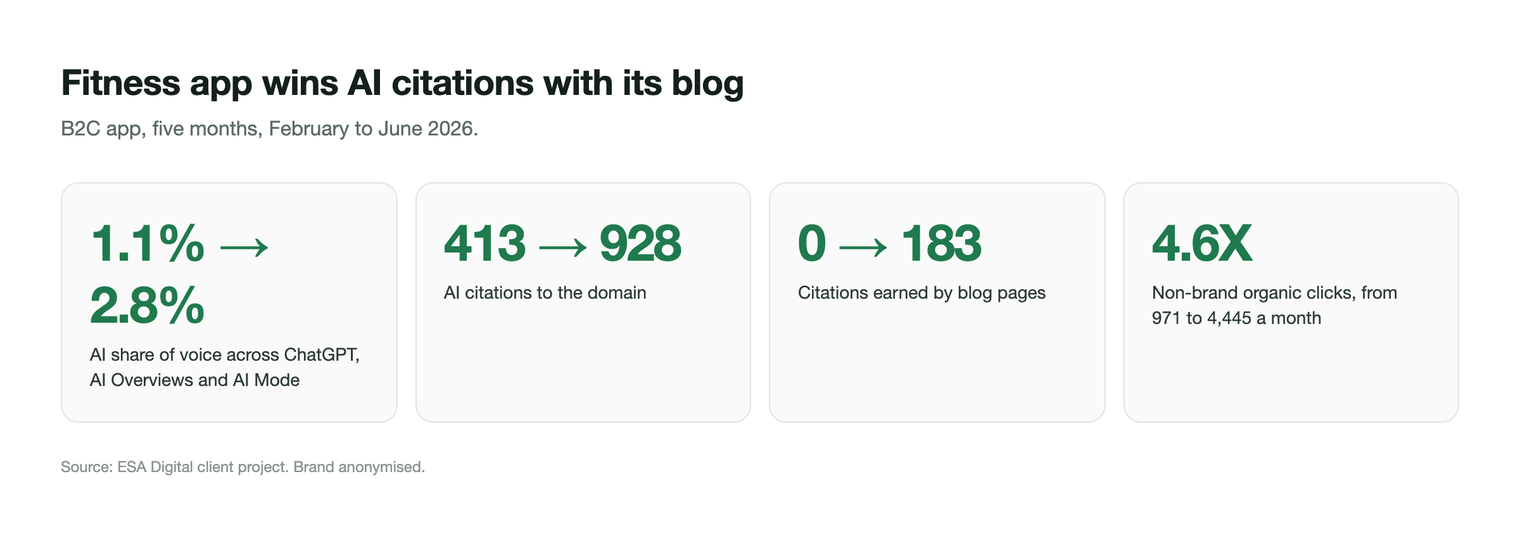
A B2C fitness app was cited by AI mostly for support pages such as how to cancel a subscription. Its blog earned no citations at all. In five months we built content for AI citation, restructured the help centre and ran placements in "best workout app" roundups.
- AI share of voice rose from 1.1% to 2.8%, and the brand overtook a direct competitor.
- AI citations grew from 413 to 928.
- The blog went from zero to 183 citations, and one article became the most cited page on the domain.
- Non-brand organic clicks grew from 971 to 4,445 a month.
Read the full fitness app case study.
Case: a machinery marketplace rebuilds 3,000 pages for answer extraction
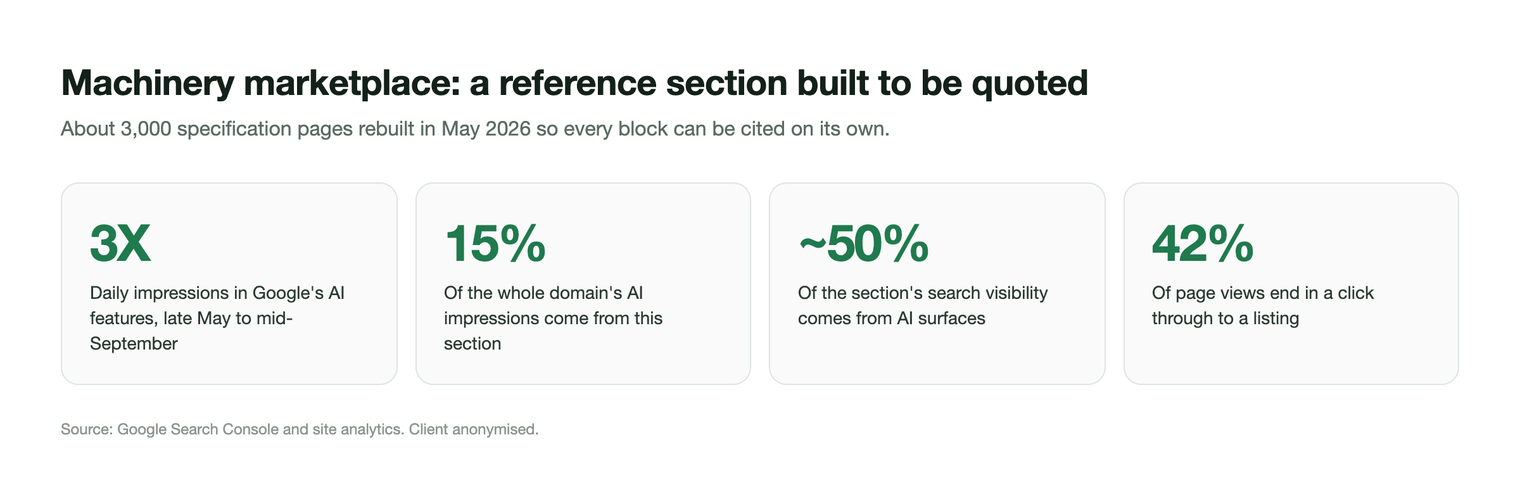
A European marketplace for commercial vehicles had listings but no pages that answered "what is this model and what are its specifications". We built a reference section for it from scratch. In May 2026 about three thousand pages were rebuilt on one rule: every block must be quotable on its own.
- The title and description state the model, production years and key figures with units.
- A self-contained definition paragraph opens the page.
- Each subsystem (engine, dimensions, fuel system) has its own table.
- Every page compares the model with its neighbours and says when it is a poor fit.
- An FAQ with structured data closes the page.
The results, measured in Search Console and Ahrefs Brand Radar:
- Daily impressions in Google's AI features roughly tripled between late May and mid-September, while the rest of the domain stayed flat.
- A few thousand pages now bring 15% of the whole domain's impressions in AI features, on a site with millions of listing pages.
- About half of the section's search visibility comes from AI surfaces.
- 42% of page views end in a click through to a listing, and the section brings dozens of leads a month.
- AI encyclopedias and answer assistants started linking to the pages without any outreach.
What these three projects have in common
None started with tricks. All three started with a measurement of where the brand stood in AI generated answers, and all three paired on-page AEO work with regular SEO. In each, organic traffic and AI visibility grew together. If you want the same analysis for your brand, see our AEO agency and GEO services pages, or book a call.
How to measure AEO
Answer engine optimization needs its own scorecard, and it should sit next to the other numbers in your marketing strategy. Rankings and sessions tell you about traditional organic search. They say little about whether answer engines quote you.
The metrics that matter
- AI citations. How often your pages are linked as a source, and which pages.
- Brand mentions. How often your name appears in an answer, with or without a link.
- Share of voice. Your mentions against competitors across a fixed set of prompts.
- AI referral traffic. Sessions from chatgpt.com, perplexity.ai, gemini.google.com and similar referrers.
- Conversions from that traffic. Sign-ups, demos and revenue.
- Branded search. People who saw you in an answer often search your name later.
The tools
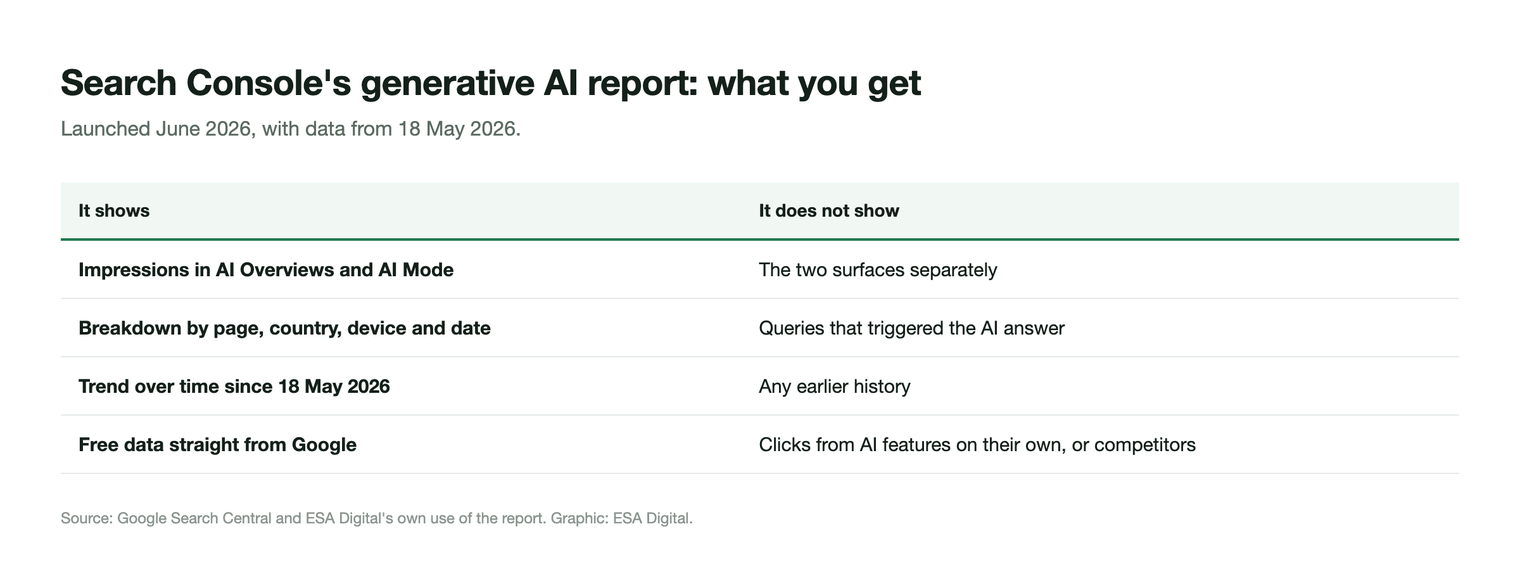
Google Search Console. Since June 2026 it has Search generative AI performance reports. They show impressions in AI Overviews and AI Mode combined, by page, country and device. They do not show queries, and clicks are still folded into the web totals. It is a free start, not a full picture.
Google Analytics. The default channel grouping now has a built-in AI Assistant channel, so AI referral traffic and its conversions are reported without custom setup. It undercounts, because many AI visits arrive without a referrer, but the trend is reliable.
AI visibility tools. Trackers run a set of prompts on a schedule and record who is named and cited. We compared twelve of them in our guide to the best AI visibility tool.
Surveys. Add "How did you hear about us?" to your sign-up or demo form. It catches the buyers who met you in an AI answer and typed your address directly.
What not to expect
Do not expect a stable number. An AI answer is generated fresh each time, so AI responses vary between runs, users and days, and according to RESONEO 43% of Gemini answers that used search showed no sources at all. Track a fixed prompt set over weeks and look at the trend. One screenshot proves nothing in either direction.
Should you opt out? Google's AI controls explained
Google now gives site owners several switches that affect how content is used in AI answers. They do different jobs, and they are easy to confuse.
| Control | Where | What it does | Side effect |
|---|---|---|---|
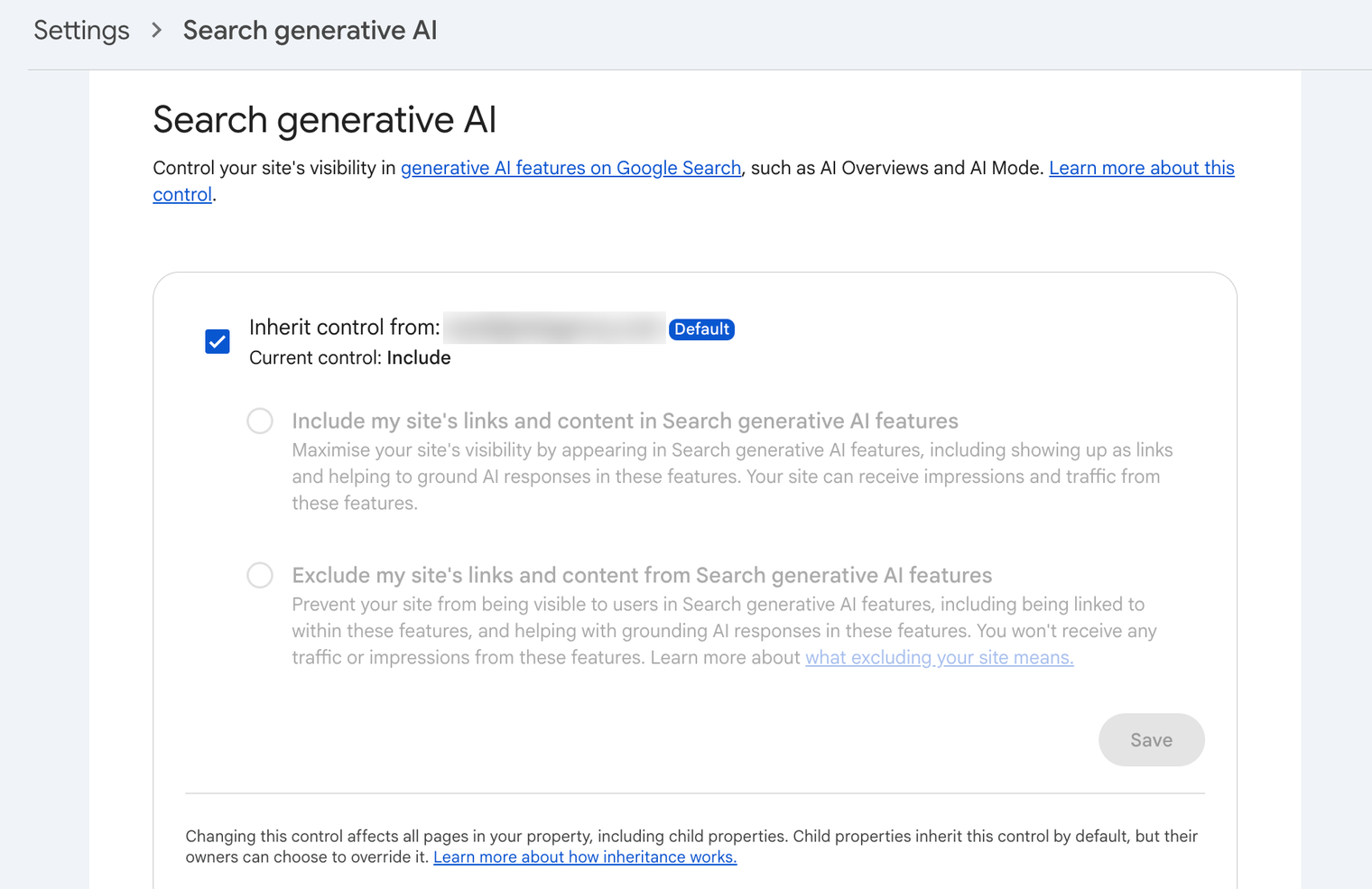
| Search generative AI setting | Search Console: Settings, AI controls, Search generative AI | Includes or excludes the site's links and content from generative AI features in Search, such as AI Overviews and AI Mode. One switch for all of them | You lose the citations and the visits they bring. Google says the setting is not a ranking signal for regular results |
nosnippet | Robots meta tag or HTTP header | Blocks any snippet from the page, including use in AI Overviews | The classic snippet under your blue link disappears too |
data-nosnippet | HTML attribute on an element | Keeps one part of a page out of snippets and AI answers | None for the rest of the page |
max-snippet | Robots meta tag | Limits how many characters can be quoted | Shorter classic snippets |
Google-Extended | robots.txt | Controls use of your content for Gemini training and grounding | Does not remove you from AI Overviews or AI Mode |
noindex | Robots meta tag | Removes the page from Google altogether | No search traffic at all |
The Search Console setting has three states: Include, Exclude and, for a child property, Inherit. A change applies to every page in the property and to its child properties, unless their owners override it.
What we recommend
For a brand that sells something, stay included. Opting out does not bring the clicks back. The AI answer still appears, built from your competitors' pages, and your name is no longer in it. The businesses with a real case for opting out are publishers whose product is the content itself.
Use the narrow tools instead. Put data-nosnippet on the parts you do not want quoted, such as gated research or pricing that changes weekly. Leave Google-Extended as a separate decision about model training. And check the setting after any site migration: child properties inherit the control by default, so a subdomain may be excluded without anyone on your team having chosen it.
Common AEO mistakes
- Treating it as a schema project. Markup without a quotable passage changes nothing.
- Chasing AI search and dropping traditional SEO. Pages that are not retrieved are not cited.
- Writing for machines. Stiff, keyword-heavy text loses human readers and gains nothing with AI models that paraphrase anyway.
- Publishing only on your own site. One host is one vote, however many pages you add.
- Changing dates without changing content. Freshness is judged on what the page says.
- Reporting clicks only. You will conclude AEO failed in the month it started to work.
- Blocking the wrong thing. Disallowing Google-Extended and expecting to leave AI Overviews, or adding nosnippet and losing classic snippets too.
- Checking one engine. A win in AI Overviews says little about ChatGPT or other answer engines.
Frequently asked questions
Is AEO replacing SEO?
No. AEO depends on SEO. Answer engines find most of their sources through traditional search, so a page that cannot rank is rarely cited. AEO adds a second goal to the same page: being quoted in the answer, not only listed under it.
How long does AEO take to show results?
Citations can appear within days of publishing or of a new third-party mention, which is faster than rankings. A measurable shift in share of voice usually takes three to six months, because it needs a body of content and mentions, not one page.
Does AEO reduce my website traffic?
AEO does not reduce traffic. Direct answers on the results page do, whether you optimise for them or not. An AEO strategy decides whether your brand is named in those answers. The visits you keep tend to come from people further along in their decision.
Do I need new content, or can I optimise existing content?
Start with existing content. Pages that already rank on the first or second page are the closest to being cited. Rewrite the opening so it gives direct answers, tighten the headings and add missing facts. Write new pages for questions you do not cover.
Does structured data guarantee a place in AI Overviews?
No. Structured data helps search engines identify your page and your company, and it supports rich results. Research into Google's AI features found no direct effect of schema markup on AI Overviews. Clear passages and consistent facts matter more to AI systems.
How is AEO different from optimising for voice search?
Voice search was the first form of AEO, and voice assistants were the first answer engines most people used. A voice assistant reads one short answer, usually taken from a featured snippet. The same answer-first writing now serves AI Overviews and AI Mode, which compose longer replies from several sources.
Is answer engine optimization worth it?
It is worth it when your buyers research with AI before they talk to sales, which is now the norm in SaaS and apps. The cost is low if you already invest in SEO, because most of the work improves pages you have. The risk of skipping it is being absent from the shortlist.
Can a small brand compete in answer engines?
Yes. In our check of this very topic, 21 of 120 cited pages came from domains rated below 60. RESONEO also found that 51% of Gemini answers with sources cited at least one site outside the top million by popularity. AI systems select on the quality and relevance of the passage, so a specialist page can be cited ahead of a larger site.
The bottom line
Answer engine optimization (AEO) is not a replacement for search engine optimization, and it is not a new digital marketing channel that needs a separate team. It is the next requirement for the content you already publish: be findable, be quotable, and be described the same way wherever AI looks.
The business case is simple. Buyers increasingly read an answer before they see a list of links, and answer engines decide which brands that answer names. A brand that appears in that answer enters the shortlist. A brand that does not is compared against competitors it never sees. If you want to know which of those describes you today, book a discovery call and we will show you the data for your category.
